

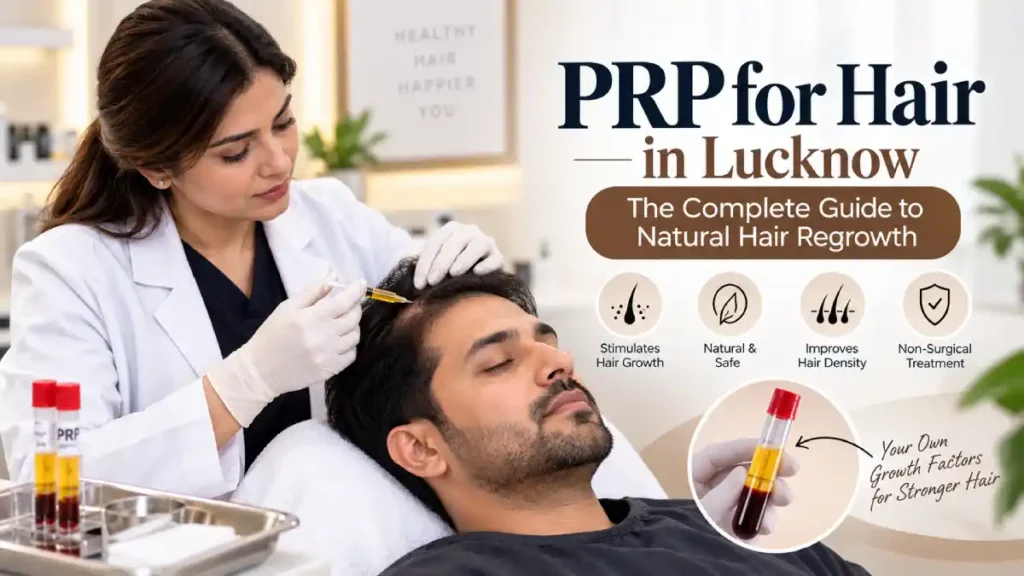
Are you struggling with thinning strands or a receding hairline? Many residents of Lucknow are seeking effective solutions to restore their confidence. Platelet-Rich Plasma (PRP) therapy has emerged as a popular, non-surgical option to revitalize dormant follicles.
At The Velvet Skin Centre, we prioritize your wellness through evidence-based care. Dr. Asma Parveen, with over 14 years of clinical experience, has successfully guided more than 5,000 patients toward healthier scalps. She emphasizes that while this advanced medical procedure supports weakened roots, it is not a magic cure for total baldness.
This comprehensive guide covers everything you need to know—from the science behind PRP to what you can realistically expect.
Ready to Explore Your Options?
If you are curious about how PRP can help you achieve healthier, fuller hair, we are here to guide you. Book a consultation with Dr. Asma to discuss your unique hair profile and goals.
Key Takeaways
- PRP harnesses your body’s own growth proteins to support healthier, stronger hair follicles.
- With more than 14 years of clinical experience, Dr. Asma Parveen personally guides every consultation.
- The treatment is gentle and non-surgical, allowing you to return to your routine right away.
- Results vary by individual, often requiring multiple sessions for optimal density.
- Professional diagnosis at The Velvet Skin Centre ensures safety and realistic expectations.
What Is PRP for Hair?
PRP for hair in Lucknow is a fully natural treatment—it relies entirely on your own blood rather than any synthetic ingredient. A small sample is collected from your arm, spun in a medical-grade centrifuge to isolate the platelet-rich portion, and then carefully delivered into areas of the scalp where thinning is most noticeable.
These platelets are rich in naturally occurring growth proteins that enhance circulation to the hair roots, prolong the active growth phase, and encourage weakened follicles to produce fuller, stronger strands. Because the benefits usually fade after a few months, follow-up sessions are advised to maintain the improvement.
Quick Fact: Clinical research shows PRP can boost hair density by 30–40% in patients treated during the early-to-moderate stages of hair loss.
How PRP Works: The Science Behind the Treatment
Understanding how PRP works can help you feel more confident about your treatment. The process follows a precise biological mechanism.
Step 1: Blood Collection and Processing
The procedure starts with a quick blood sample, much like a standard lab test. This sample is placed into a specialized centrifuge that spins at high speeds to separate the platelet-rich plasma from other blood components.
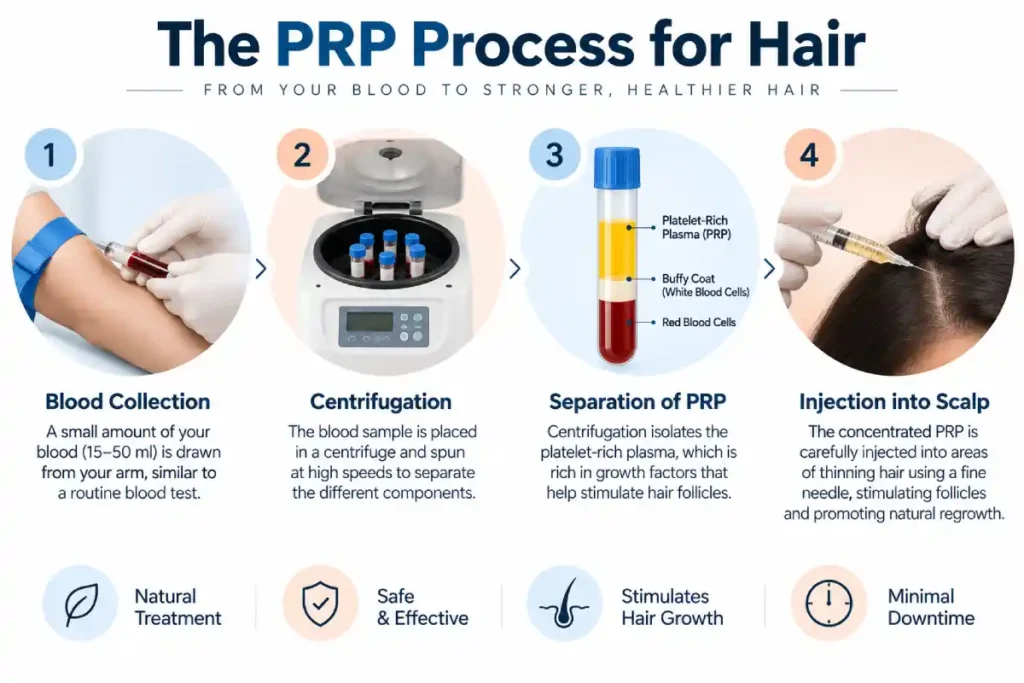
Step 1: Blood Collection and Processing
The procedure starts with a quick blood sample, much like a standard lab test. This sample is placed into a specialized centrifuge that spins at high speeds to separate the platelet-rich plasma from other blood components.
Step 2: Isolation of Growth Factors
Once concentrated, the plasma becomes a potent serum rich in growth factors. These growth factors act as a wake-up call for dormant or miniaturized hair follicles.
Step 3: Injection into the Scalp
Using very fine needles, the concentrated plasma is then delivered into the specific zones of the scalp that need it most. By improving blood supply and nutrient delivery, PRP helps create a healthier environment for hair to thrive.
Step 4: Follicle Stimulation
The growth factors stimulate weakened follicles, encouraging them to produce thicker, healthier hair strands over time. This is a natural approach that complements your body’s existing biological processes.
Who May Benefit from PRP?
Identifying the root cause of your hair concerns is vital before starting any treatment plan. The treatment delivers the strongest results when begun early—ideally within the first year of noticing thinning.
PRP Is Suitable For:
Condition | How PRP Helps |
Early-to-moderate androgenetic alopecia | Strengthens existing follicles before they become inactive |
Diffuse hair thinning | Supports overall scalp health and reduces shedding |
Telogen effluvium | Addresses stress, illness, or post-COVID hair fall |
Post-partum hair loss | Helps when hair loss has not naturally resolved |
Post-transplant support | Supports healing of donor and recipient areas |
PRP Is Less Effective For:
- Complete baldness where hair follicles have stopped functioning
- Scarring alopecia
- Individuals taking blood-thinning medication or living with certain bleeding conditions
- Hair loss linked to untreated thyroid, nutritional, or hormonal concerns
A thorough evaluation ensures you are not spending time and resources on a treatment that may not address your primary issue.
What Happens During a PRP Session?
Understanding the clinical process helps ease any nerves and ensures you feel confident in your decision.
Consultation and Scalp Examination
Every session begins with a thorough evaluation. Dr. Asma examines your scalp to determine the underlying cause of thinning and assesses the health of your follicles using trichoscopy.
Blood Collection and Preparation
A modest blood sample (15–50 ml) is taken from your arm. This blood is placed into a centrifuge, which spins at high speeds to separate the nutrient-rich plasma from other components.
Scalp Cleansing and Targeted Injections
After the plasma is ready, your scalp is thoroughly cleansed. The practitioner then uses a fine needle to inject the plasma into the areas of the scalp experiencing the most thinning.
Session Duration and Sensation
Most sessions last between 45 and 60 minutes. While individual sensitivity varies, most patients describe the sensation as a series of minor pinpricks or mild pressure. There is no downtime—you can resume your regular routine immediately.
How Many Sessions Are Needed?
Achieving optimal hair health through PRP therapy typically involves a structured series of sessions.
Typical Treatment Schedule
Phase | Sessions | Frequency |
Initial Phase | 3–6 sessions | Every 4–6 weeks |
Maintenance Phase | Ongoing | Every 6–12 months |
If you stop treatment after the initial phase, hair loss may gradually return to its previous pattern. Maintenance sessions are what protect your long-term investment and keep your results stable.
Factors That Influence the Timeline
- Stage and cause of hair loss – Earlier stages respond faster
- Age, genetics, and general health – Younger patients often see faster results
- Consistency with treatment – Skipping appointments disrupts the stimulation cycle
Results Timeline: What to Realistically Expect
Achieving natural hair regrowth is a gradual process that requires patience and consistent care.
Timeline | Expected Milestone | Focus Area |
Weeks 1–4 | Scalp stabilization | Reduced inflammation |
Months 2–3 | Decreased shedding | Follicle stimulation |
Months 4–6 | Visible density | Shaft thickening |
Months 6+ | Maintenance phase | Long-term retention |
It is important to understand that biological hair restoration is not an overnight transformation. Because hair grows in cycles, the stimulation of dormant follicles takes time to manifest as visible growth.
PRP vs. GFC: Which Is Right for You?
Both PRP and GFC (Growth Factor Concentrate) are effective regenerative treatments, but they work differently.
Feature | PRP | GFC |
Best For | Mild-to-moderate hair loss | Moderate-to-severe hair loss |
Contains | Platelets + Red/White Blood Cells | Only Concentrated Growth Factors |
Ideal For | First-line treatment | When PRP response was insufficient |
Sessions Needed | 3–6 sessions | 3–4 sessions |
Results | Gradual improvement | Often faster results |
Dr. Asma Parveen can evaluate your specific hair loss pattern to determine which approach is most suitable for you.
Is PRP Safe? Side Effects and Precautions
Because PRP uses your own blood, the risk of allergic reactions is very low. In a properly sterilized clinical setting, significant side effects are uncommon.
Common, Temporary Effects
Effect | Duration | Management |
Mild tenderness | A few hours | Gentle scalp care |
Redness | A few hours | Cool compress |
Slight swelling | A few hours | Avoid tight headwear |
Who Should Avoid PRP?
PRP may not be suitable for patients with certain bleeding disorders, active scalp infections, or those on blood-thinning medications. A one-on-one consultation will confirm whether PRP is appropriate for your individual needs.
When to Contact Your Dermatologist
- Intense pain, swelling, or redness that persists beyond 48 hours
- Fever
- Signs of infection
Aftercare Tips for Best Results
Proper aftercare is vital for achieving the best results. Below are the essential steps to follow once your session is complete.
Do:
- Wash your hair with a gentle, sulfate-free shampoo on the morning of your appointment (this is the most important prep step)
- Eat a light meal and drink plenty of water before you arrive
- Let Dr. Asma know about any blood thinners or medications you are taking
Don’t:
- Drink alcohol for 48 hours leading up to your session
- Wash your hair for at least 6–8 hours post-treatment
- Exercise vigorously or use saunas for 24 hours
- Color or chemically treat hair for 72 hours
You will receive a full written aftercare guide following each session.
What Our Patients Say
Ram Sewak
“PRP karwaya for hair fall and results are amazing. Hair fall control ho gaya. Best skin specialist in Lucknow.”
Areeba Adeeba
“Consulted Dr. Asma Parveen at The Velvet Skin Centre. Took PRP treatment—it was very effective.”
Ayan Sheikh
“Acne scars mein bahot improvement hua. Took MNRF and PRP alternate with fractional CO2 laser.”
Why Choose The Velvet Skin Centre?
Feature | The Velvet Skin Centre |
Expertise | Led by Dr. Asma Parveen, MD Dermatology, with 14+ years of experience |
Technology | Medical-grade centrifuge and FDA-approved PRP kits |
Safety | Sterile, clinical-grade injection technique |
Locations | Indira Nagar and Thakurganj – convenient across Lucknow |
Patient Care | Clear, upfront pricing with no hidden charges, plus thorough aftercare guidance |
Frequently Asked Questions
Q1: Does PRP really work for hair loss?
Yes, for many individuals, it is an effective way to support thinning hair. While results can vary based on genetics and the stage of thinning, PRP has helped thousands of patients at The Velvet Skin Centre. Studies indicate noticeable improvement in roughly 70–80% of patients treated in the early-to-moderate stages of hair loss.
Q2: How many sessions of PRP are usually required?
Most patients typically require an initial series of 3 to 6 sessions, spaced about a month apart. After the initial phase, maintenance sessions every few months help sustain results.
Q3: Is PRP safe for hair and are there any side effects?
Because PRP uses your own blood, it is considered very safe with minimal risk of allergic reactions. The most common side effects include mild tenderness, redness, or slight swelling at the injection site, which usually clears up within a day or two.
Q4: Can this treatment help both men and women?
Absolutely. PRP is effective for both male pattern baldness and female pattern hair loss. It is an excellent non-surgical solution for women experiencing widening parts or general thinning across the scalp.
Q5: Should I consider PRP after hair transplant surgery?
Many patients find that PRP after hair transplant surgery supports the healing process. The growth factors can help newly transplanted grafts settle in and may promote faster, healthier growth in the treated areas.
Q6: How much does PRP treatment cost in Lucknow?
PRP hair treatment typically costs between ₹3,000 and ₹12,000 per session, depending on the treatment area and number of sessions needed. A personalized consultation provides the most accurate estimate.
Q7: Do I need any tests before starting PRP?
A routine blood test is usually advised first to check for issues such as anaemia or clotting problems that might influence your results or safety.
Q8: How will I know if PRP isn’t working for me?
If you see no noticeable change in shedding or density after 4–5 sessions, PRP alone may not be the best path for you. At that point, it is worth exploring options such as GFC or a transplant assessment with your dermatologist.
Q9: Are there any long-term risks with repeated PRP sessions?
Repeated PRP sessions have not been linked to any major long-term risks, as the treatment relies on your own blood rather than an external agent. The only things to keep in mind are the same minor, temporary effects each time—there is no cumulative risk.
Ready to Start Your PRP Journey?
Hair loss does not pause—and neither should you. The sooner you begin PRP treatment, the better your long-term results are likely to be.
Successful hair restoration relies on selecting the right treatment and finding a skilled practitioner. Your journey starts with prioritizing safety and personalized care.
Visit Our Clinics
Indira Nagar: The Velvet Skin Centre, Amrapali Market, 23, B Block, Indira Nagar, Lucknow, Uttar Pradesh 226016
Thakurganj: The Velvet Skin Centre, Near Ghante Wala Sweets, Thakurganj, Daulatganj, Lucknow, Uttar Pradesh 226003.
Your journey to healthier, fuller hair starts with a simple conversation. We look forward to meeting you