

If you live in Lucknow, you have probably noticed it: as soon as the rains arrive, your hair starts falling more than usual. You see it on your pillow, in your comb, or swirling down the bathroom drain. And you are not alone.
Dr. Asma Parveen, a trusted skin specialist in Lucknow with over 14 years of experience, regularly sees patients concerned about increased hair shedding during the monsoon. The good news is that this condition is temporary and treatable. But with so many options available, how do you choose between PRP and GFC?
We have already covered the reasons behind monsoon hair fall in our previous blog. Now, let us focus on the two most advanced solutions available today — backed by clinical research.
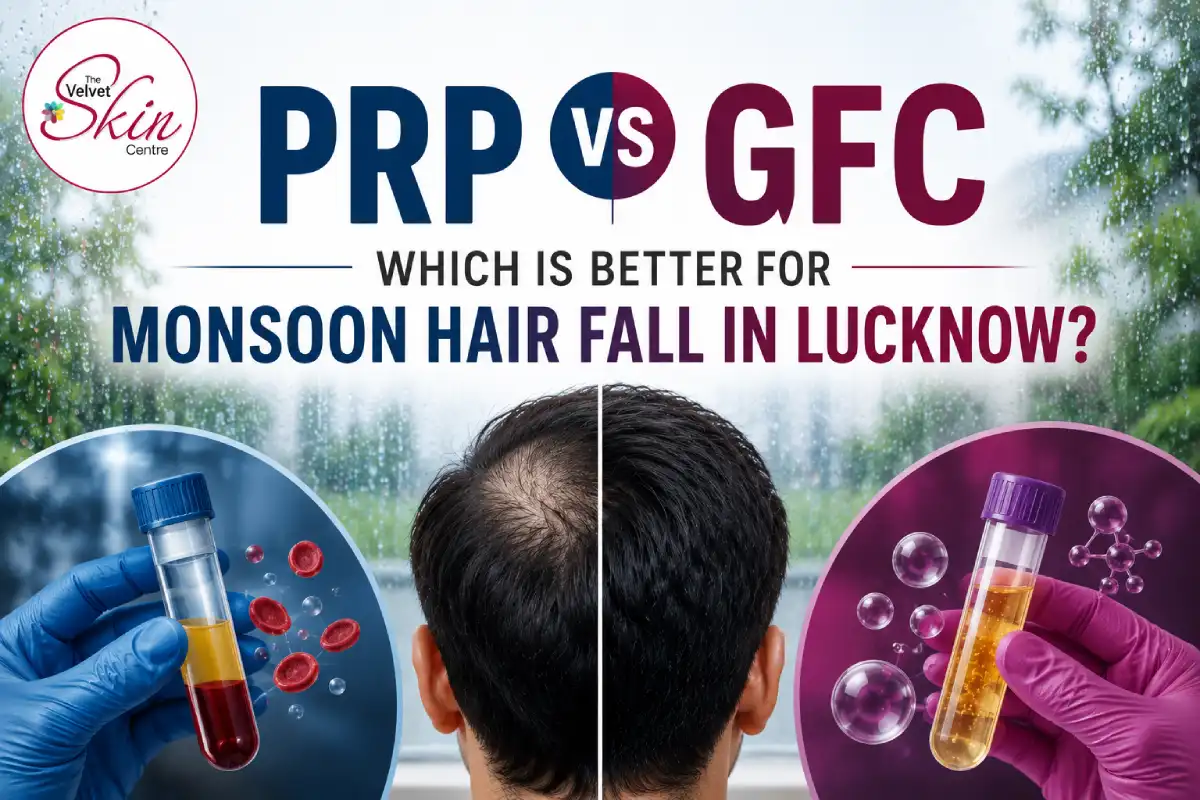
What Are PRP and GFC?
Both PRP and GFC are non-surgical treatments that use your body’s own healing properties to stimulate hair growth. They are often described as regenerative therapies because they work with your body’s natural repair mechanisms rather than introducing foreign substances.
PRP (Platelet-Rich Plasma) has been used for years in dermatology and hair restoration. A small amount of your blood is drawn and placed in a centrifuge, which spins at high speed to separate the platelet-rich plasma from other blood components. This concentrated plasma, rich in growth factors, is then injected into your scalp. These growth factors signal weak or dormant hair follicles to start growing again.
GFC (Growth Factor Concentrate) is a more advanced and refined version of PRP. The key difference lies in what gets injected. In GFC, red blood cells, white blood cells, and other cellular components are removed. Only the pure growth factors are kept — and at a concentration that is 3 to 5 times higher than standard PRP. The preparation also uses a specialised closed kit, not a regular centrifuge, which makes the process more controlled and the results more consistent.
Think of it this way: PRP delivers intact platelets that release growth factors gradually over hours or days after injection. GFC, on the other hand, provides a more immediate availability of soluble growth factors. Both work, but they work differently.
PRP vs. GFC: Head-to-Head Comparison
Feature | PRP | GFC |
Growth Factor Concentration | Standard | 3 to 5x higher than PRP |
Blood Components Injected | Platelets and plasma | Pure growth factors only |
Post-Treatment Inflammation | Mild to moderate | Very low |
Pain Level | Mild to moderate | Minimal |
Sessions Required | 4 to 6 sessions | 3 to 4 sessions |
Session Frequency | Every 3 to 4 weeks | Every 4 to 6 weeks |
Visible Results | 3 to 6 months | 2 to 3 months |
Cost Per Session | More affordable | Slightly higher |
Best Suited For | Early-stage hair thinning | Moderate to advanced thinning |
What the Research Says
A clinical study published in Dermatologic Surgery compared PRP and GFC in 42 patients with pattern hair loss. The findings were revealing:
- GFC showed better outcomes in total hair count, shaft diameter, and Global Aesthetic Improvement Scale (GAIS) scores, with significant improvements appearing after just the second session
- GFC also showed more bulbar enlargement, while PRP resulted in more erythema and angiogenesis
- At 6 months, PRP demonstrated better hair diameter and GAIS scores, suggesting a more sustained long-term effect
The study concluded that GFC provides quick improvement, while PRP offers long-term benefits — and recommended using both sequentially for sustainable results.
A systematic review and meta-analysis published in Aesthetic Plastic Surgery analysed 12 studies with 745 patients. The data showed:
- GFC: Progressive hair density gains from 19.6 hairs/cm² at 1 month to 57.1 at 12 months
- PRP: Density increased by 34.4 at 6 months and 42.0 at 12 months
- GFC also improved hair thickness (5.19 to 22.03 µm) with 94.3% patient satisfaction
Another comparative study showed that clinical trials have demonstrated a 50% increase in hair density with GFC versus 35% with PRP over a comparable course.
Which Treatment Should You Choose?
PRP May Be a Better Option If:
- You have early-stage hair thinning
- You prefer a cost-effective, time-tested method
- You are looking for long-term, sustained results
GFC Could Be a Better Option If:
- You are seeking faster, more noticeable results (2–3 months vs 3–6 months for PRP)
- You prefer fewer sessions and minimal downtime
- You are addressing more advanced hair loss concerns
- You want less post-treatment discomfort
Ultimately, the choice depends on your individual needs, hair condition, and treatment goals — ideally determined after a personalised assessment by a qualified dermatologist.
What You Can Do at Home
While PRP and GFC are powerful treatments, daily care matters too. You can protect your hair during the rainy season by adopting a few simple habits:
- Maintain scalp hygiene by washing your hair 2–3 times weekly using a gentle, sulfate-free shampoo. If rain soaks your hair, rinse it promptly to keep fungal infections at bay.
- Dry your hair properly – Avoid leaving your hair wet for long. Gently dry it with a microfiber towel.
- Avoid tight hairstyles – Tight ponytails or braids can pull on weak hair and increase breakage.
- Eat a balanced diet – Include protein-rich foods, leafy greens, and citrus fruits to support hair growth.
- Cover your hair when going out – Use an umbrella or scarf to protect your hair from rainwater and pollutants.
When Should You Consult a Skin Specialist?
If your hair fall is severe, persistent, or accompanied by itching, redness, or bald patches, it is time to consult a dermatologist. A thorough scalp assessment helps identify whether the underlying cause is seasonal, hormonal, or nutritional, allowing for a customised treatment approach.
At The Velvet Skin Centre in Indira Nagar & Thakurganj Lucknow, Dr. Asma Parveen and her team analyse the root cause and offer advanced solutions like PRP, GFC, and Exosome Hair Therapy to restore scalp health and boost growth.
Take Charge This Monsoon – Your Hair Health Matters
Monsoon hair fall in Lucknow is real, but it does not have to be permanent. With the right care and timely professional guidance, you can restore stronger, healthier hair. Both PRP and GFC offer safe, effective solutions — the key is choosing the one that best fits your needs.
As clinical research shows, GFC offers faster visible results (often by month 2 vs month 4 for PRP) with fewer sessions, while PRP provides sustained long-term benefits. For some patients, a sequential approach — starting with GFC for quick improvement followed by PRP for maintenance — may offer the best of both worlds.
If you are noticing more hair in your comb than usual, do not wait. A timely consultation can make all the difference.
Ready to Take Control of Your Hair Health?
If excessive hair fall is bothering you this monsoon, reach out to Dr. Asma Parveen for a personalised consultation at The Velvet Skin Centre. We will assess your scalp, understand your concerns, and recommend a personalised treatment plan — whether it is PRP, GFC, or simply expert guidance on hair care.
Call us at +91-8002558860 to book your appointment online today. Your hair deserves expert care.
Visit us at our two convenient locations:
Indira Nagar: The Velvet Skin Centre, Amrapali Market, 23, B Block, Indira Nagar, Lucknow, Uttar Pradesh 226016
Thakurganj: The Velvet Skin Centre, Near Ghante Wala Sweets, Thakurganj, Daulatganj, Lucknow, Uttar Pradesh 226003
Frequently Asked Questions
- Which is better for monsoon hair fall — PRP or GFC?
Both treatments are effective. Research shows GFC offers faster results with fewer sessions, while PRP provides longer-lasting benefits. The best choice depends on your specific hair condition and goals. - How many sessions do I need for visible results?
PRP typically requires 4–6 sessions, while GFC usually needs 3–4 sessions. Visible improvements with GFC often appear within 2–3 months, compared to 3–6 months with PRP. - Is GFC more expensive than PRP?
Yes, GFC is slightly more expensive per session due to the advanced technology and specialised kits used. However, because fewer sessions are needed, the total cost may be comparable. - Does GFC cause less pain than PRP?
Yes. Because GFC removes cellular components that trigger inflammation, patients typically experience less pain and minimal downtime compared to PRP. - Can I combine PRP and GFC treatments?
Yes. Clinical research suggests that using both sequentially — GFC for quick improvement followed by PRP for sustained benefits — may offer the best results. Your dermatologist can guide you based on your specific needs.
References:
- https://tressless.com/research/prp-vs-gfc-in-pattern-hair-loss-treatment-DA5Y
- https://link-hkg.springer.com/article/10.1007/s00266-026-05910-3
- https://ijdvl.com/evaluation-of-the-safety-and-efficacy-of-platelet-rich-plasma-in-the-treatment-of-female-patients-with-chronic-telogen-effluvium-a-randomised-controlled-double-blind-pilot-clinical-trial/#F1