

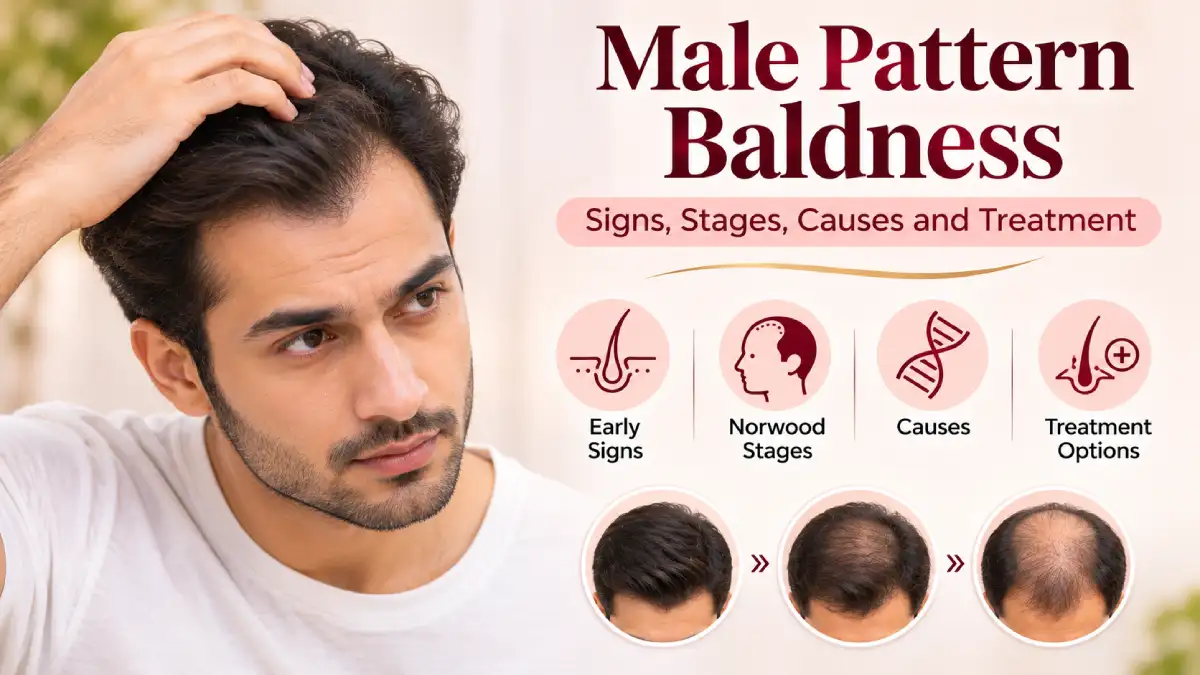
Summary: Male pattern baldness is gradual, inherited hair loss in which the hairline recedes at the temples and the crown thins, caused by hair follicles that are sensitive to the hormone DHT. It often starts in the 20s or 30s and tends to progress without treatment. It can’t be permanently cured, but treatment started early can slow or stop it, and some men regain thickness. A dermatologist can confirm the cause, track your stage and plan treatment, and decide whether a hair transplant is suitable later.
It often starts with something small. Your hairline looks a little higher in old photos. The corners at your temples seem deeper. A friend jokes about the bright spot on your crown, or you notice more scalp under the bathroom light when your hair is wet. Many young men wonder whether it’s stress, their shampoo or the cap they wear every day.
In most cases, this pattern is male pattern baldness, the most common reason men lose hair. In this guide, Dr Asma Parveen, a dermatologist in Lucknow, explains how to recognise it early, what drives it, how it is diagnosed, and the options that can realistically help.
What is male pattern baldness?
Male pattern baldness, medically called androgenetic alopecia, is a genetic condition in which hair follicles on the front and top of the scalp become sensitive to DHT (dihydrotestosterone), a hormone made from testosterone. Over the years, DHT causes these follicles to shrink. Each new hair grows back thinner and shorter, until some follicles stop producing visible hair.
The hair at the back and sides of the head is usually resistant to DHT, which is why most men keep a horseshoe-shaped ring of hair even in advanced stages. This is also why hair from the back of the scalp can be used in a hair transplant.
How common is it?
Male pattern baldness accounts for the large majority of hair loss in men. According to the American Hair Loss Association, around two-thirds of men notice some hair loss by the age of 35, and about 85% have noticeably thinner hair by 50. It is not contagious, and it does not affect your general physical health, although it can affect confidence and mood.
Curious how this differs from hair loss in women? Read our guide to male vs female pattern hair loss.
Early signs of male pattern baldness
- Receding temples: the corners of the hairline move back, forming an “M” shape
- A higher hairline in photos than a few years ago
- Thinning at the crown: a small circular patch at the top-back of the head
- Finer, shorter hairs along the hairline and crown
- More scalp visible when hair is wet or under bright light
- Hair that won’t hold its style as it used to
Mature hairline or receding hairline?
Many men in their late teens and 20s notice their hairline moving back slightly. Often this is a mature hairline, a normal change where the hairline settles about a finger’s width higher, evenly across the forehead, and then stays stable.
A receding hairline from male pattern baldness keeps moving back, usually deeper at the temples than in the centre, and is often accompanied by thinning at the crown. If you’re unsure, a dermatologist can tell the difference with a scalp examination and trichoscopy.
A simple photo check at home
Every 3 months, take two photos in the same light: one of your hairline with your hair pushed back, and one of your crown from above using your phone’s front camera or with someone’s help. Comparing them over time shows whether your hair loss is stable or progressing.
Stages of male pattern baldness: the Norwood scale
Dermatologists commonly use the Norwood scale to describe how far male pattern baldness has progressed.
Norwood stage | What it looks like |
Stage 1 | Normal adult hairline with no noticeable recession |
Stage 2 | Slight recession at the temples; often a mature hairline |
Stage 3 | Clear, deeper recession at the temples (the earliest stage usually called balding). Stage 3 vertex: recession plus thinning at the crown |
Stage 4 | Further recession at the front and a larger bald area at the crown, separated by a band of hair |
Stage 5 | The band between the front and crown becomes thinner |
Stage 6 | The front and crown bald areas join, leaving hair mainly at the sides and back |
Stage 7 | Only a horseshoe-shaped band of hair remains around the sides and back |
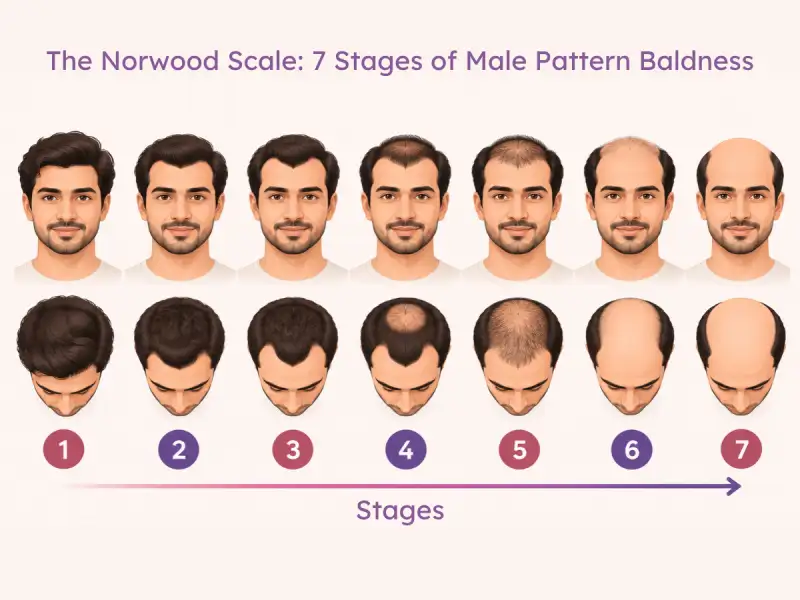
The speed of progression varies widely from person to person. Some men stay at an early stage for years, while others progress faster, especially when it starts young.
Why do I have male pattern baldness?
Genetics
Family history is the biggest factor. A common belief is that baldness comes only from your mother’s father, but the tendency can be inherited from either side of the family. If your father, grandfathers or uncles lost hair early, your risk is higher.
DHT sensitivity
Most men with male pattern baldness don’t have unusually high testosterone. Instead, their hair follicles on the front and top of the scalp are genetically more sensitive to DHT, which gradually shrinks them.
Age
Male pattern baldness can begin soon after puberty, and many men notice the first signs in their 20s. It becomes more common with each decade of life. Teenagers with hair loss should always see a doctor first, because some medicines used in adults, such as finasteride, are generally not prescribed under 18.
Things that can speed it up or make it look worse
- Anabolic steroids or testosterone taken without medical need, commonly misused for bodybuilding, which can raise androgen levels and speed up hair loss
- Smoking, which has been linked with earlier and more severe hair loss in some studies
- Crash dieting, very low protein intake and rapid weight loss
- Ongoing stress, poor sleep and illness, which can add shedding on top of pattern loss
- Thyroid problems or low iron and vitamin D, which can cause additional hair fall
Does any deficiency cause male pattern baldness?
Male pattern baldness is not a nutrition problem. If your follicles are DHT-sensitive, even a perfect diet won’t stop it. But many young men in Lucknow have a second, fixable problem on top of it: shedding from a strict cutting diet, skipped meals, a mostly vegetarian diet low in B12, or long hours indoors with little sun. When both happen together, hair can thin much faster than pattern loss alone would explain.
Red flag in your routine | What a doctor may check |
Heavy shedding 2 to 3 months after a crash diet or quick weight loss | Protein intake, haemoglobin and ferritin |
Mostly vegetarian meals with little milk, curd or paneer | Vitamin B12 |
Desk job, little time in daylight | Vitamin D |
Tiredness, weight change, always feeling cold | Thyroid (TSH) |
Recent fever such as typhoid or dengue | Usually no test needed; this shedding often settles on its own within a few months |
Tests are ordered only when your history points to them. If a level is low, fixing it can calm the extra shedding, but receding temples and crown thinning still need pattern hair loss treatment.
Male pattern baldness or another type of hair loss?
Type | How it starts | What you notice | Common trigger |
Male pattern baldness | Gradually, over years | Receding temples, thinning crown | Genetics and DHT |
Sudden shedding (telogen effluvium) | Suddenly, 2 to 3 months after a trigger | Diffuse hair fall all over the scalp | High fever, illness, surgery, crash diets, severe stress |
Alopecia areata | Suddenly | Round, smooth bald patches on the scalp or beard | The immune system attacking hair follicles |
Traction alopecia | Gradually | Thinning at the hairline or temples | Tight man buns, ponytails or regular use of tight caps |
Fungal scalp infection | Over weeks | Itchy, scaly patches with broken hairs | Fungal infection, often spread by sharing combs or caps |
Scarring alopecia | Gradually | Shiny patches, sometimes with redness, pain or itching | Inflammation that destroys follicles; needs early treatment |
Because some of these need very different treatment, it’s worth getting a proper diagnosis before trying hair loss products.
How is male pattern baldness diagnosed?
A diagnosis usually takes one visit and needs no special preparation. Bring a few old photos if you have them, as they show how fast things are changing. A typical men’s hair consultation goes like this:
- The conversation. Your doctor asks when you first noticed the change, whether your father, brothers or maternal uncles went bald, and about anything that may be adding to it: whey or mass gainers, anabolic steroids or testosterone injections, recent illness, smoking, sleep and stress.
- Hairline and crown check. The temples, mid-scalp and crown are examined separately, and your Norwood stage is noted so later visits have a clear starting point.
- Dermoscope view. Trichoscopy magnifies the scalp without any pain. In pattern baldness it shows thick and thin hairs mixed in the same area, which separates it from alopecia areata, a scalp infection or simple shedding.
- Shedding check. A gentle pull on a small bunch of hairs shows whether there is active hair fall alongside the slow thinning.
- Tests only if something doesn’t fit. Blood work is ordered when your history or scalp suggests a second cause, not as a routine package.
The trichoscopy images and photos taken at this first visit become your baseline. Comparing them every few months is the most reliable way to judge whether treatment is helping.
Can male pattern baldness be stopped or reversed?
Think of male pattern baldness as a slow, ongoing process rather than a one-time event. DHT keeps acting on sensitive follicles for as long as it is left unchecked, so the realistic aim of treatment is to hold your current stage and rebuild density where follicles are still alive.
- Hold the line: many men who treat consistently stay at the same Norwood stage for years.
- Rebuild density: thin, wispy hairs at the crown and mid-scalp can grow thicker, because those follicles are shrinking but not gone.
- Know the limit: a smooth, shiny temple corner or crown that has been bare for a long time has usually lost its follicles. Medicines can’t bring those back, and that is where a transplant enters the discussion.
Timing matters more than the choice of product. A man who starts at Norwood 2 has far more hair to protect than one who waits until Norwood 5. Treatment also works only while you use it: if you stop, the hair you gained or held is usually lost again within about a year.
Can male pattern baldness be prevented?
You can’t change your genes, so male pattern baldness can’t be fully prevented. But you can delay its progress and protect the hair you have by starting treatment early, avoiding anabolic steroids, not smoking, treating dandruff and deficiencies, and keeping regular check-ups if it runs in your family.
Treatment options for male pattern baldness
The right plan depends on your age, stage, health and goals. Most men get the best results from a combination of treatments started early.
Topical minoxidil
Minoxidil is a lotion or foam applied to the scalp once or twice a day. It lengthens the growth phase of hair and may thicken thinning areas. In men it tends to work better on the crown and mid-scalp than on a deeply receded temple, so it is often combined with another treatment when the hairline is your main worry.
- Put it on the skin of your scalp, not on the hair strands, and let it soak in for around four hours before you bathe or sweat it off at the gym.
- A short shed in the first month or two can happen as older hairs make way for new ones. It is not by itself a reason to stop.
- Judge it at six months, not six weeks.
- Itching or flaking is sometimes caused by an ingredient in the lotion; your doctor may switch you to a foam.
- The gains last only as long as you keep applying it.
Finasteride and other prescription medicines
Finasteride is a prescription tablet that lowers the amount of DHT in the scalp. It is one of the most studied treatments for male pattern baldness and can slow hair loss and improve density in many men.
Like any medicine, it can have side effects. A small number of men report changes in sex drive, erection or ejaculation, which usually settle when the medicine is stopped. Some men are anxious about these effects, and that’s a valid concern to discuss openly with your dermatologist, who can explain the benefits and risks for you. Take finasteride only when a doctor has prescribed it. Keep the tablets away from women who are pregnant or planning a pregnancy, as the medicine can be absorbed through the skin from a broken or crushed tablet.
Your dermatologist may also consider low-dose oral minoxidil or, in selected cases, dutasteride, another DHT-lowering medicine,, with appropriate monitoring.
PRP and GFC
PRP (platelet-rich plasma) and GFC (growth factor concentrate) use growth factors from your own blood, injected into thinning areas of the scalp. They are usually given as a series of sessions and work best as part of a combined plan rather than on their own. Results vary from person to person.
Low-level laser therapy (LLLT)
Laser caps, combs and helmets use low-level light to stimulate hair follicles. Some studies show a modest improvement in density, but the effect is usually smaller than with medicines, so they are best seen as an add-on rather than a main treatment. Ask your dermatologist before buying a device.
Hair transplant
A hair transplant moves DHT-resistant hair follicles from the back of the scalp to thinning or bald areas. It may suit men who:
- Have stable hair loss, not rapidly progressing
- Have a good donor area at the back and sides
- Have realistic expectations about density
It is usually not the first step for very young men whose pattern is still evolving. Medical treatment is generally still needed after a transplant, because it protects the existing (non-transplanted) hair from continuing to thin.
Camouflage options
While treatment works, a shorter haircut, a textured style, hair fibres or scalp micropigmentation can make thinning less noticeable.
Treatment options by stage
Norwood stage | Options a dermatologist may consider |
2 to 3 (early) | Topical minoxidil, finasteride, correcting deficiencies |
3 vertex to 4 (moderate) | Combination medical treatment, PRP or GFC |
5 to 6 (advanced) | Medical treatment to protect remaining hair, hair transplant in suitable cases |
7 (very advanced) | Limited options; transplant depends on donor hair, camouflage |
Medicines such as finasteride and minoxidil, and procedures like PRP or a transplant, each carry their own possible side effects, and how well they work differs from man to man. Your dermatologist will go through these with you, including what happens if you stop, before you choose.
What to expect: a realistic treatment timeline
Checkpoint | What may be happening | What to do |
First 2 months | Hair fall may rise briefly, especially with minoxidil | Keep going; it’s too early to judge |
Months 3 to 4 | Daily hair fall usually slows | Take your first comparison photos |
Month 6 | Crown and mid-scalp may look fuller | Review visit to continue, adjust or add a treatment |
Month 12 | The clearest picture of how well you respond | Agree on a long-term maintenance plan |
Year 2 onwards | Results are kept with continued use | Yearly review, and a transplant discussion if needed |
Take each photo in the same spot, under the same light and with the same hair length, with one shot from above for the crown. Gym mirrors and selfies with styled hair can make progress look better or worse than it really is.
Gym, supplements and hair loss: what young men should know
Many young men who work out worry that their gym routine is causing hair loss.
- Whey protein: there is no good evidence that plain whey protein causes male pattern baldness. Some protein products are mixed with added hormones or steroid-like substances, so choose reputable brands.
- Creatine: one small study found a rise in DHT levels in men taking creatine, but it didn’t measure hair loss, and later research has not shown that creatine causes baldness. If you have a strong family history and are concerned, discuss it with your doctor.
- Anabolic steroids and testosterone boosters: these can genuinely speed up hair loss in men who are genetically prone, besides carrying other serious health risks. Avoid them unless prescribed for a medical condition.
- Exercise itself does not cause baldness, and regular activity is good for overall health.
Other everyday habits that help
- Wash your hair regularly with a mild shampoo; keeping the scalp clean doesn’t increase hair loss.
- Treat dandruff, as an itchy, inflamed scalp can add to hair fall.
- Avoid tight caps, helmets and hairstyles worn for long hours without a break, and keep caps and helmet liners clean.
- Eat enough protein from dal, paneer, eggs, chicken, fish, sprouts or soya.
- Quit smoking, sleep well and manage stress.
Common myths about male pattern baldness
Myth | Fact |
Baldness comes only from your mother’s side | It can be inherited from either parent. |
Wearing caps or helmets causes baldness | Normal use doesn’t cause pattern baldness; very tight headwear worn constantly can cause traction and breakage. |
Washing hair daily makes you go bald | The hairs you see while washing were already shed. |
Hard water causes baldness | Hard water can make hair feel rough and break more easily, but it doesn’t cause male pattern baldness. |
Masturbation or sex causes hair loss | There is no scientific evidence linking either to male pattern baldness. |
Dandruff makes you go bald | Dandruff can add to hair fall through itching and scratching, but it doesn’t cause pattern baldness. |
Oiling and onion juice can reverse baldness | They don’t affect DHT or the genetic cause. |
Shaving your head makes hair grow back thicker | Shaving doesn’t change how follicles grow. |
Only older men go bald | Male pattern baldness often starts in the 20s, sometimes even in the late teens. |
Once you start hair loss medicine, quitting will make you go bald quicker | Quitting doesn’t speed up baldness. The hair the medicine was protecting simply goes back to the path it would have taken without treatment. |
Is male pattern baldness linked to health problems?
Male pattern baldness is mainly a cosmetic concern, but some studies, including research from India, have found a link between early-onset baldness and a higher risk of heart disease. This doesn’t mean baldness causes heart problems. However, if you’re losing hair at a young age, it’s a good reason to keep an eye on your overall health, including blood pressure, blood sugar, cholesterol and weight.
Losing hair in your 20s can knock a man’s confidence, especially before a wedding, a job interview or in a photo-heavy friend circle. If it’s weighing on you, tell your doctor; that worry is a fair part of the treatment conversation.
Questions to ask your dermatologist
- Is my hairline receding because of pattern loss, or is it just maturing?
- What Norwood stage am I at today, and how fast has it moved?
- Is finasteride suitable for me, and how will we watch for sexual side effects?
- Should I stop or change any gym supplements?
- Can treating now help me delay or avoid a hair transplant?
- If I need a transplant later, do I have enough donor hair at the back of my head?
When to see a dermatologist
Don’t wait until the change is obvious to everyone else. Book a visit if:
- Your temples look deeper in photos taken a year apart, or friends have started pointing at your crown
- You are a student or in your early 20s and already see thinning; the younger you start, the more you keep
- Your father or brothers lost their hair early and you want to protect yours
- Hair is falling out in round patches on the scalp or beard, which points to a different condition
- Your scalp has itching, redness, pus bumps or scaling
- Hair fall suddenly increased after starting steroids, testosterone or a new medicine
- You are weighing up a hair transplant and want an honest view on timing
At The Velvet Skin Centre, Dr Asma Parveen examines your scalp, uses trichoscopy where needed, identifies your type and stage of hair loss, and suggests a plan suited to you. You can learn more about our hair fall treatment for men in Lucknow.
Clinic information
Indira Nagar: The Velvet Skin Centre, 23, Amrapali Market, B Block, Indira Nagar, Lucknow – 226016
Thakurganj: The Velvet Skin Centre, Near Ghante Wala Sweets, Daulatganj, Thakurganj, Lucknow – 226003
Call: 8002558860
Frequently asked questions
1. At what age does male pattern baldness start?
It can begin in the late teens, though most men first spot a deeper hairline corner or a thinner crown in their 20s or early 30s. The older a man gets, the more likely he is to have some degree of it.
2. Can male pattern baldness be stopped?
It can’t be cured permanently, but treatment can slow or stop further loss in many men, and some regain thickness, especially when they start early.
3. Is a receding hairline always male pattern baldness?
No. A slight, even rise of the hairline in your late teens or 20s can be a normal mature hairline. Deepening temples along with crown thinning are more typical of male pattern baldness.
4. Does male pattern baldness come from the mother’s side?
No, that’s an old belief. Genes from both parents play a part, so look at the men on both sides of your family, not just your nana’s side.
5. Does creatine or whey protein cause hair loss?
There’s no good evidence that whey protein or creatine causes male pattern baldness. The real concern is steroid cycles and testosterone injections taken for bodybuilding, which raise androgen levels and can bring baldness on sooner in men already at risk.
6. How long does it take for treatment to work?
Most men need 6 to 12 months to see a clear result. Some notice extra shedding in the first few weeks with minoxidil, which usually settles.
7. What happens if I stop treatment?
The hair gained or kept through treatment is usually gradually lost over the following months, as the hair loss returns to its natural course.
8. Can I regrow hair on a completely bald area?
Areas that have been bald and shiny for many years rarely regrow with medicines. For those spots, your dermatologist may discuss a transplant using hair from the back of your head, provided you have enough donor hair there.
9. At what age can I get a hair transplant?
There’s no fixed age, but transplant is usually considered once the pattern of hair loss has become more stable, and after medical treatment has been tried.
10. Do caps and helmets cause baldness?
Normal use doesn’t cause male pattern baldness. Very tight headwear worn for long hours may cause breakage, so keep it clean and well fitted.
11. How much hair fall is normal in a day?
Seeing roughly 50 to 100 hairs on your comb, pillow or bathroom drain each day is part of the normal hair cycle. In male pattern baldness the bigger issue isn’t how many fall, but that each new hair comes back finer and shorter than the one before.
12. Is male pattern baldness contagious?
No. It is genetic and hormone-related, and can’t be passed on through combs, caps or contact.
13. Is treatment for male pattern baldness lifelong?
To keep the results, most medical treatments need to be continued long term. Your dermatologist can adjust the plan over time based on your progress.

Dr Asma Parveen, MD (Dermatology)
Founder of The Velvet Skin Centre and Dr Asma M.D. Skin Clinic, Chowk, with over 14 years of experience treating skin and hair concerns in Lucknow. She consults at Indira Nagar, Thakurganj and Chowk.
Note : This article shares general information about male pattern baldness and does not replace a personal examination by a dermatologist. Medicines such as finasteride and minoxidil should be started, changed or stopped only under medical supervision. Response to any treatment differs between individuals.
References
- Androgenetic alopecia: an evidence-based treatment update. PubMed.
- Treatment options for androgenetic alopecia: efficacy, side effects, compliance, financial considerations, and ethics. PubMed.
- Finasteride: a review of its use in male pattern hair loss. PubMed.
- Androgenetic alopecia: an update on pathogenesis and pharmacological treatment. Drug Design, Development and Therapy.
- Examine.com. Does creatine cause hair loss?
- Medical Dialogues. Male pattern baldness and premature greying associated with risk of early heart disease.
- American Hair Loss Association. Men’s hair loss.