

Summary: Female pattern hair loss (FPHL) is gradual thinning of hair on the top of the head, usually seen as a widening centre parting, while the front hairline stays mostly intact. It is linked to genetics and to how sensitive the hair follicles are to hormones. It can’t be permanently cured, but treatment started early can slow it down, and many women notice thicker-looking hair within 6 to 12 months. Checking for iron, vitamin D, B12 and thyroid problems is an important part of the plan.
Maybe you’ve noticed it in a group photo: your parting looks wider than it used to. Or your ponytail feels thinner, and more of your scalp shows under bright bathroom lights. You aren’t losing clumps of hair, but your hair simply doesn’t look as full as it once did.
In many women, this gradual loss of fullness turns out to be female pattern hair loss, which accounts for more hair thinning in women than any other cause. In this guide, Dr Asma Parveen, a dermatologist in Lucknow, explains how to recognise it, why it happens, how it is diagnosed, and what can realistically be done about it.
What is female pattern hair loss?
Known medically as androgenetic alopecia, and sometimes called female pattern baldness, female pattern hair loss happens when the follicles on the top of the scalp slowly become smaller. Over time, each follicle produces a thinner, shorter and lighter hair, until some stop producing visible hair at all.
It is different from ordinary hair fall. Hair fall usually shows up as extra strands on your comb or pillow for a short spell. With female pattern hair loss, the main change is that the hairs growing back are finer, so the hair looks less dense even when you don’t notice much shedding.
Wondering how it differs in men? Read our guide to male vs female pattern hair loss.
Early signs: what does female pattern hair loss look like?
Female pattern hair loss usually develops slowly over months or years. Common signs include:
- A widening centre parting: often the first thing women notice
- A “Christmas tree” pattern: the parting looks wider towards the front of the head
- Less fullness over the crown and top of the scalp
- A front hairline that stays mostly in place, unlike the receding hairline seen in men
- A thinner ponytail or plait than before
- More scalp showing under direct light or in photos
- Finer, shorter hairs around the parting
A 2-minute check you can do at home
- Part your hair in the centre, the same way each time.
- Stand under the same light, such as a bathroom light, and take a clear photo of your parting from above.
- Repeat every 3 months and compare the photos side by side.
If the parting looks steadily wider, or more scalp is visible over time, it’s worth getting your scalp checked by a dermatologist. These photos are also useful to show your doctor.
Don’t part your hair in the centre? Female pattern hair loss can still show up as reduced volume on the top of the head, a thinner crown, or hair that won’t hold its shape.
Stages of female pattern hair loss
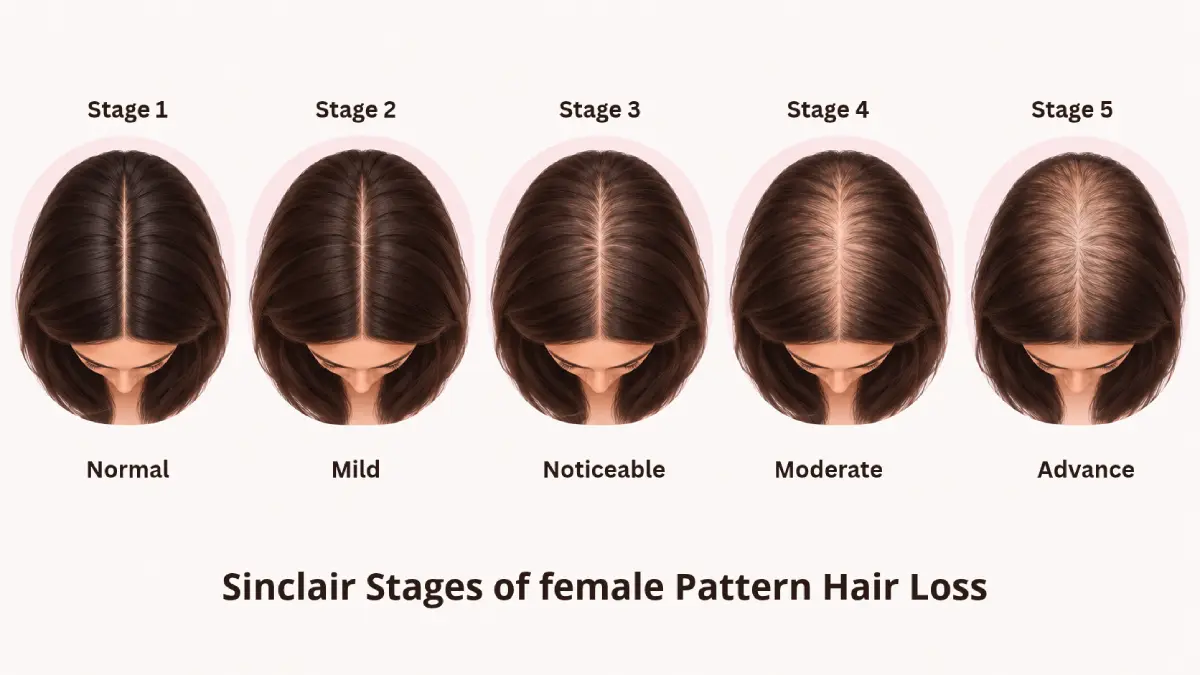
Dermatologists often use scales to describe how advanced the thinning is. The two most common are the Ludwig scale and the Sinclair scale.
Sinclair stage | What it looks like | Ludwig equivalent |
Stage 1 | Normal, narrow parting | No visible thinning |
Stage 2 | Parting slightly wider than normal | Grade I (mild) |
Stage 3 | Parting clearly wider, with thinner hair on either side | Grade I to II |
Stage 4 | Visible thinning across the top of the head | Grade II (moderate) |
Stage 5 | Marked thinning over the top and crown, with scalp clearly visible | Grade III (advanced) |
For the majority of women, the condition remains a matter of reduced density rather than bald areas. Complete baldness, as can happen in men, is rare in women.
Why do I have female pattern hair loss?
There is rarely one single cause. Female pattern hair loss usually develops from a mix of genes and hormones, and other factors can make it show up earlier or look worse.
Genetics
A family history of thinning hair is one of the strongest risk factors. The tendency can come from either your mother’s or your father’s side of the family, not just your mother’s, as many people believe.
Hormones and follicle sensitivity
In some women, hair follicles on the top of the head are more sensitive to androgens, hormones such as DHT. This sensitivity gradually shrinks the follicles. Many women with female pattern hair loss have normal hormone levels; it is often the follicles’ sensitivity, rather than high hormones, that matters.
Life stages that can bring it out
- PCOS (PCOD): higher androgen levels can speed up thinning, often along with acne or unwanted facial hair. Read more in our guide on PCOS skin and hair care.
- After pregnancy: heavy shedding a few months after delivery is common and usually temporary, but it can reveal underlying pattern thinning that was developing quietly.
- Perimenopause and menopause: falling oestrogen levels make female pattern hair loss more common in the late 40s and 50s.
Things that make it worse, but don’t cause it alone
- Ongoing stress, crash dieting or rapid weight loss
- Illness, high fever or surgery
- Thyroid problems
- Low iron, vitamin D or protein
At what age does it start?
It can begin as early as the 20s or 30s, especially with a family history or PCOS, but it becomes more common with age, particularly around and after menopause.
What deficiency causes female pattern hair loss?
Female pattern hair loss isn’t caused by any one missing nutrient. However, some deficiencies are very common in Indian women and can cause extra shedding, making thinning look worse and slowing your response to treatment. Research on how closely they are linked to pattern hair loss is mixed, which is why testing is better than guessing.
Nutrient | How it can affect hair | Test your doctor may suggest |
Iron | Low iron stores are a common cause of diffuse shedding | Haemoglobin and serum ferritin |
Vitamin D | Low levels are common in Indian women and have been linked with hair loss in some studies | Serum vitamin D (25-OH) |
Vitamin B12 | Deficiency is common in vegetarian diets and can affect hair and energy | Serum B12 |
Protein | Hair is made of protein; very low intake or crash diets can increase shedding | Diet history |
Thyroid hormones | Both underactive and overactive thyroid can cause hair fall | TSH (thyroid test) |
About biotin: biotin supplements help only if you are actually deficient, which is uncommon. High doses can also affect some blood test results, including thyroid tests, so tell your doctor if you’re taking them.
Female pattern hair loss or another type? How to tell them apart
Thinning hair in women can have several different causes, and they don’t all look the same. Getting the type right matters, because the treatment is different.
Type | How it starts | Where you notice it | What usually triggers it |
Female pattern hair loss | Gradually, over months or years | Parting and crown; front hairline mostly kept | Genetics and hormone sensitivity |
Telogen effluvium (sudden shedding) | Suddenly, 2 to 3 months after a trigger | All over the scalp; lots of hair on the comb | Fever, childbirth, surgery, crash diets, severe stress |
Traction alopecia | Gradually | Hairline and temples | Tight braids, buns, a tight juda or heavy hair extensions |
Alopecia areata | Suddenly | Round, smooth bald patches | The immune system attacking hair follicles |
Thyroid-related hair loss | Gradually | Diffuse thinning, sometimes outer eyebrows | Underactive or overactive thyroid |
It’s also common to have two problems together, such as pattern thinning plus extra shedding caused by low iron. Seasonal shedding can also add to it; read more about why hair fall increases in winter.
How is female pattern hair loss diagnosed?
Female pattern hair loss is usually diagnosed in the clinic, based on how your hair looks and your history. A typical evaluation includes:
- Your history: when the thinning started, family history, periods, pregnancy, recent illness, diet, medicines and hair styling habits
- Scalp examination: looking at the pattern of thinning, the width of the parting and the hairline
- Trichoscopy: a magnified, painless scalp check using a dermatoscope. In female pattern hair loss, it often shows hairs of varying thickness side by side, with more thin hairs on the top of the head than at the back. This view also lets the doctor spot signs of other conditions, like patchy alopecia or an inflamed scalp.
- Hair pull test: gently pulling a small bunch of hairs to see how many come out, which helps judge active shedding
- Blood tests, if needed: commonly a complete blood count, ferritin, vitamin D, B12 and thyroid (TSH). If there are signs of PCOS, such as irregular periods, acne or unwanted hair, hormone tests may be added.
A scalp biopsy is needed only rarely, when the diagnosis is unclear.
Can female pattern hair loss be fixed or reversed?
There is currently no permanent cure for female pattern hair loss, and without treatment it usually continues slowly over time. Even so, there is a lot that can be done to keep it under control.
With the right treatment:
- Further thinning can often be slowed or stopped
- Many women notice less shedding and thicker-looking hair
- Some women see partial regrowth, especially when treatment starts early
The earlier you start, the better the results tend to be, because treatment works best on follicles that are still producing hair, even if those hairs are thin. Treatment also needs to continue to maintain the results; stopping usually leads to thinning returning gradually over a few months.
Treatment options for female pattern hair loss
Treatment is planned after diagnosis, based on the stage of thinning, your age, your health, and whether you are pregnant, breastfeeding or planning a pregnancy. Most women do best with a combination rather than a single treatment.
Topical minoxidil
Applied directly to the scalp, minoxidil is often the first treatment dermatologists turn to for female pattern hair loss, and it has been researched for decades. It helps prolong the hair’s growth phase and may thicken thinning hairs.
- In the first few weeks, you may shed a little more than usual. This is usually temporary and often a sign that old hairs are making way for new growth.
- It takes several months to see results.
- It needs continued use to maintain results.
- Possible side effects include scalp irritation and, sometimes, unwanted facial hair.
Oral medicines prescribed by a doctor
For some women, the dermatologist may add a tablet to the plan, such as:
- Low-dose oral minoxidil for suitable women, with monitoring for side effects such as unwanted hair growth, ankle swelling or a fast heartbeat
- Anti-androgen medicines such as spironolactone, particularly when there are signs of high androgens, as in PCOS. These are not suitable during pregnancy, so reliable contraception is usually advised while taking them.
Some medicines used for male pattern hair loss are not safe for women who could become pregnant. Never take hair loss tablets without a prescription.
PRP and GFC
PRP (platelet-rich plasma) and GFC (growth factor concentrate) use growth factors from your own blood, injected into the thinning areas of the scalp. They are usually given as a series of sessions, often alongside medical treatment. Results vary from person to person.
Treating the underlying causes
Correcting low iron, vitamin D or B12, and managing thyroid problems or PCOS with your gynaecologist or endocrinologist, can reduce extra shedding and help other treatments work better.
Hair transplant for women
A hair transplant is less common in women than in men, because female thinning is usually spread across the top of the scalp rather than limited to one area. It may suit some women with stable, localised thinning and good donor hair at the back of the head. Medical treatment is usually still needed afterwards to protect existing hair.
Camouflage and styling
While treatment takes effect, simple steps can make thinning less noticeable: a side parting, volumising haircuts, coloured hair fibres, or a hair topper for advanced thinning.
Treatment options by stage
Stage | Options a dermatologist may consider |
Early (Sinclair 2) | Topical minoxidil, correcting deficiencies, gentle hair care |
Moderate (Sinclair 3 to 4) | Topical or oral minoxidil, anti-androgen medicines where suitable, PRP or GFC |
Advanced (Sinclair 5) | Combination medical treatment, PRP or GFC, camouflage, and hair transplant in selected cases |
Every treatment has possible side effects, and results vary from person to person. Your dermatologist will explain the benefits and risks before you start.
How to regrow thinning hair: a realistic timeline
Because hair grows only about a centimetre a month, improvement takes time. A typical course looks like this:
Time on treatment | What you may notice |
Weeks 2 to 8 | Possible temporary increase in shedding with minoxidil |
Months 3 to 4 | Shedding starts to settle |
Months 6 to 9 | Fine new hairs and less visible scalp in some women |
Months 9 to 12 | Clearer improvement in density, if treatment is working |
Ongoing | Maintenance treatment to keep the results |
The home parting photos are especially useful here: compare them every 3 months rather than checking daily.
Everyday hair care habits that help
Good hair care won’t cure female pattern hair loss, but it protects the hair you have and supports treatment.
Habits that help:
- Wash your hair regularly with a mild shampoo. Clean hair isn’t the problem; a buildup of oil and dandruff on the scalp can make thinning look worse.
- Choose loose hairstyles, and change your parting from time to time.
- Use a wide-toothed comb, and detangle gently from the ends upwards.
- Eat enough protein through the day, from foods such as dal, paneer, curd, eggs, sprouts, soya and chana.
- Keep a regular sleep routine, and find ways to manage ongoing stress.
Habits that can make thinning worse:
- Tight plaits, buns, a tight juda or heavy hair extensions, especially for long hours
- Frequent straightening, smoothening, keratin or rebonding treatments
- Daily high-heat styling with straighteners or curling irons
- Rubbing wet hair hard with a towel
- Crash diets or skipping meals
Myths about female hair thinning
Myth | Fact |
Oiling every day will regrow thinning hair | Oil can soften hair and reduce breakage, but it doesn’t treat the cause of female pattern hair loss. Heavy oil left on the scalp may also worsen dandruff. |
Onion juice or rice water can cure thinning | There is no strong evidence that they reverse pattern hair loss, and onion juice can irritate the scalp. |
Washing hair often makes it fall out | The hair you see in the shower was already shed. Regular washing doesn’t cause baldness. |
Thinning is “only stress” | Stress can increase shedding, but gradual thinning at the parting is often female pattern hair loss and needs proper diagnosis. |
Biotin works for everyone | It helps only if you are deficient, which is uncommon. |
Cutting hair makes it grow back thicker | Trimming removes split ends but doesn’t change how thick new hair grows from the scalp. |
Minoxidil makes your hair fall out permanently | The early shedding is usually temporary. Hair loss returns gradually only if treatment is stopped. |
Questions to ask your dermatologist
Taking these questions to your appointment can help you understand your plan:
- What type of hair loss do I have, and is more than one cause involved?
- Do I need any blood tests?
- Which treatment do you suggest for my stage, and why?
- How long before I can expect to see a change?
- What side effects should I watch for?
- How long will I need to continue treatment, and what happens if I stop?
- Is this treatment safe if I am planning a pregnancy?
When to see a dermatologist
See a dermatologist if you notice:
- Your parting getting steadily wider, or more scalp showing on top
- Hair fall that lasts longer than 2 to 3 months
- Sudden heavy shedding, or round bald patches
- An itchy, painful, red or scaly scalp
- Hair thinning along with irregular periods, acne or unwanted facial hair
- Hair loss after starting a new medicine
An early diagnosis gives you the best chance of keeping the hair you have. At The Velvet Skin Centre, Dr Asma Parveen examines your scalp, uses trichoscopy where needed, checks for underlying causes, and suggests a treatment plan suited to you. You can learn more about our hair fall treatment for women in Lucknow.
Clinic information
Indira Nagar: The Velvet Skin Centre, 23, Amrapali Market, B Block, Indira Nagar, Lucknow – 226016
Thakurganj: The Velvet Skin Centre, Near Ghante Wala Sweets, Daulatganj, Thakurganj, Lucknow – 226003
Call: 8002558860
Frequently asked questions
1. Can female pattern hair loss be fixed?
It can’t be permanently cured, but it can be managed. Treatment can slow or stop further thinning, and many women see thicker-looking hair and some regrowth, especially when they start early.
2. Why do I have female pattern hair loss?
It usually comes from a mix of genetics and hair follicles that are sensitive to hormones. PCOS, pregnancy, menopause, stress, thyroid problems and low iron or vitamin D can bring it out earlier or make it look worse.
3. How can I regrow thinning hair as a woman?
Start by finding the cause with a dermatologist. Treatment may include minoxidil, other prescribed medicines, PRP or GFC, and correcting any deficiencies. Most women need 6 to 12 months to see a clear change.
4. What deficiency causes female pattern hair loss?
No single deficiency causes it, but low iron (ferritin), vitamin D, vitamin B12 and thyroid problems can increase shedding and make thinning look worse. Your doctor may suggest blood tests to check.
5. At what age does female pattern hair loss start?
It can start in the 20s or 30s, especially with a family history or PCOS, but it is more common around and after menopause.
6. Is female pattern hair loss genetic? Does it come from my mother or father?
It often runs in families, and the tendency can be inherited from either parent.
7. Does minoxidil cause more hair fall at first?
A few women find they lose a bit more hair during the first weeks of use. This is usually temporary and settles as new hair growth begins.
8. Can women get a hair transplant for female pattern hair loss?
Some can, if thinning is stable and limited to certain areas, and there is good donor hair at the back of the head. Medical treatment is usually still needed afterwards.
9. Does biotin help female hair loss?
Only if you are deficient in biotin, which is uncommon. High doses can also affect some blood test results.
10. Is female pattern hair loss the same as hair fall?
No. Hair fall is shedding, often temporary. Female pattern hair loss is gradual thinning, where the hair that grows back is finer. You can have both at the same time.

Dr Asma Parveen, MD (Dermatology)
Founder of The Velvet Skin Centre and Dr Asma M.D. Skin Clinic, Chowk, with over 14 years of experience treating skin and hair concerns in Lucknow. She consults at Indira Nagar, Thakurganj and Chowk.
Note: This blog is for general awareness only and is not a substitute for a medical consultation. Do not start or stop any medicine without a doctor’s advice. Results vary from person to person, and every treatment carries possible risks.
References
- Female pattern hair loss: a clinical, pathophysiologic, and therapeutic review. PubMed.
- Female pattern hair loss. PubMed.
- Female-pattern hair loss: therapeutic update. Anais Brasileiros de Dermatologia.
- The efficacy and safety of oral spironolactone in the treatment of female pattern hair loss: a systematic review and meta-analysis. PubMed Central.
- Serum ferritin and vitamin D in female hair loss: do they play a role? PubMed.
- Female pattern hair loss and polycystic ovarian syndrome: more than just hirsutism. PubMed.
- Low-dose oral minoxidil for the treatment of alopecia. MDedge Dermatology.
- Simplifying the problem of hair loss in women: American Academy of Dermatology. Medical Dialogues.
- Harvard Health Publishing. Thinning hair in women: why it happens and what helps.