

Hair loss can affect both men and women, and choosing the right treatment often becomes confusing with options like PRP (Platelet-Rich Plasma) and GFC (Growth Factor Concentrate). Since both treatments use your own blood and aim to support healthier hair growth, many people assume they are the same. In reality, while they share a similar regenerative concept, they differ in how they are prepared and how they deliver growth factors to the scalp. Current clinical evidence suggests that both treatments can improve hair density and quality, but the most suitable option depends on the type of hair loss, its severity, and individual treatment goals rather than one treatment being universally better.
If you’re exploring advanced hair loss treatment in Lucknow, understanding the differences between GFC and PRP can help you have a more informed discussion with your dermatologist.
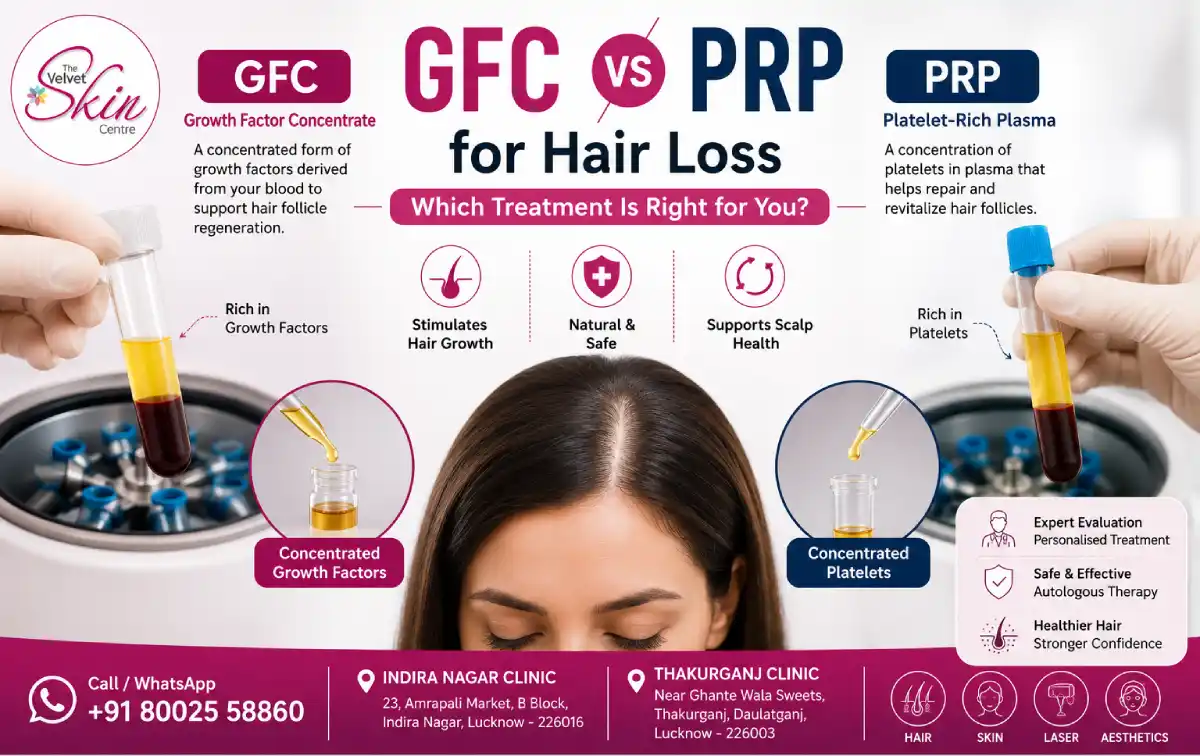
Hair Restoration Requires More Than Choosing the Latest Treatment
Hair thinning is a symptom—not a diagnosis. Factors such as genetic pattern hair loss, hormonal changes, nutritional deficiencies, stress, medical conditions, and scalp health all influence the choice of treatment. For this reason, selecting between GFC and PRP should always begin with a proper scalp evaluation rather than simply choosing the newer technology.
At The Velvet Skin Centre, Dr. Asma Parveen (MD – Dermatology) recommends regenerative hair treatments only after assessing the cause of hair loss, the stage of follicle miniaturisation, scalp condition, and long-term treatment goals. This personalised approach helps ensure that the selected treatment aligns with each patient’s clinical needs.

What Is GFC Hair Treatment?
Growth Factor Concentrate (GFC) is an autologous regenerative treatment prepared from a small sample of your own blood. During processing, growth factors released from platelets are concentrated into a purified solution, which is then injected into areas of hair thinning.
These naturally occurring growth factors help support the environment around hair follicles and are intended to encourage healthier follicle activity. Compared with traditional PRP preparation, GFC processing aims to deliver a more concentrated growth factor solution with fewer unwanted blood components, although both treatments are based on the same regenerative principle.
What Is PRP Hair Treatment?
Platelet-Rich Plasma (PRP) is another regenerative treatment prepared from your own blood. After centrifugation, platelet-rich plasma is separated and injected into the scalp. Platelets naturally contain growth factors that are released after injection and may help support follicle function and hair growth.
PRP has been used in dermatology for several years and remains one of the most commonly recommended non-surgical options for suitable candidates with pattern hair loss. Like GFC, treatment recommendations should always be based on a dermatologist’s evaluation rather than the procedure alone.
GFC vs PRP: Side-by-Side Comparison
Feature | GFC Hair Treatment | PRP Hair Treatment |
Source | Prepared from your own blood | Prepared from your own blood |
Primary Component | Concentrated growth factors | Platelet-rich plasma containing platelets and growth factors |
Treatment Goal | Support hair follicle health and regeneration | Support hair follicle health and regeneration |
Treatment Sessions | Personalised according to individual needs | Personalised according to individual needs |
Downtime | Usually minimal | Usually minimal |
Best Choice | Depends on diagnosis and scalp evaluation | Depends on diagnosis and scalp evaluation |
Although GFC is sometimes marketed as an “advanced” version of PRP, both treatments are based on regenerative medicine and continue to be evaluated in clinical studies. Some research has reported earlier improvements in certain hair parameters with GFC, while PRP has demonstrated sustained benefits over longer follow-up in other measures. This highlights why treatment selection should be individualised rather than based on marketing claims.
How Do Dermatologists Choose Between GFC and PRP?
Although GFC and PRP are both regenerative treatments, there isn’t a single treatment that’s ideal for everyone. Dermatologists consider several factors before recommending one over the other, including the underlying cause of hair loss, the stage of follicle miniaturisation, age, scalp health, previous treatments, and long-term expectations.
For example, someone with early androgenetic alopecia may benefit from regenerative therapy as part of a comprehensive treatment plan, whereas a person with hair loss caused by nutritional deficiencies, thyroid disorders, or other medical conditions may first require treatment for the underlying cause. This is why a proper diagnosis is more important than simply choosing the latest procedure.
Who May Benefit from GFC Hair Treatment?
After a dermatologist’s evaluation, GFC may be considered for individuals who:
- Have early to moderate hair thinning.
- Prefer regenerative treatments prepared from their own blood.
- Are looking for a treatment that focuses on concentrated growth factors.
- Want to include regenerative therapy as part of a personalised hair restoration plan.
The suitability of GFC depends on the diagnosis and the presence of active hair follicles rather than age alone.
Who May Benefit from PRP Hair Treatment?
PRP may be considered for individuals who:
- Have androgenetic (pattern) hair loss.
- Notice gradual thinning or reduced hair density.
- Wish to support medical hair loss treatments with regenerative therapy.
- Are suitable candidates following a scalp assessment.
PRP remains one of the most widely used regenerative treatments in dermatology, with a growing body of evidence supporting its role in appropriately selected patients.
Can GFC and PRP Be Combined?
In selected situations, a dermatologist may recommend incorporating regenerative treatments alongside medical therapies or other hair restoration procedures. Whether GFC, PRP, or a combination approach is appropriate depends on the diagnosis, treatment goals, and clinical findings rather than a standard protocol for every patient.
The objective is always to recommend the treatment strategy that is most suitable for the individual’s condition instead of assuming one option is universally better.
Dermatologist’s Perspective
Patients often ask whether GFC is “better” than PRP. In clinical practice, the answer is rarely that simple.
Both treatments are based on regenerative medicine and have demonstrated benefits in appropriately selected patients. Rather than focusing on marketing terms or newer technology, the priority should be identifying the cause of hair loss and selecting the treatment that best fits the individual’s clinical needs.
Common Myth vs Fact
Myth: GFC always produces better results than PRP.
Fact: Both GFC and PRP have shown positive outcomes in hair restoration studies, but current evidence does not support one treatment as the universal winner. The most appropriate choice depends on the type of hair loss, scalp evaluation, and treatment objectives.
Quick Take
Treatment Type | Regenerative hair restoration treatment |
Common Uses | Pattern hair loss and hair thinning |
Downtime | Usually minimal |
Treatment Choice | Based on dermatologist evaluation |
May Be Combined With | Medical hair loss treatments when appropriate |
Treatment Selection Matters
Choosing between GFC and PRP should never be based solely on advertisements or online comparisons. A successful hair restoration plan begins with identifying why hair loss is occurring.
Depending on the diagnosis, regenerative treatments may be recommended alongside prescription medications, nutritional correction, scalp care, or other dermatologist-guided therapies. A personalised approach often provides more meaningful long-term results than relying on any single procedure.
Final Insight
Both GFC and PRP represent important advances in regenerative hair restoration. They share the common goal of supporting healthier hair follicles, but they are not interchangeable for every individual. The most suitable treatment depends on careful clinical evaluation, realistic expectations, and a personalised treatment plan.
If you’re considering regenerative therapy for hair loss, a dermatologist consultation is the best way to determine which option aligns with your diagnosis and long-term hair restoration goals.
Consultation & Next Step
If you’re exploring GFC or PRP for hair loss in Lucknow, a detailed scalp assessment can help identify the most appropriate treatment for your condition.
At The Velvet Skin Centre, Dr. Asma Parveen (MD – Dermatology) provides personalised hair restoration plans based on clinical evaluation, scalp analysis, and individual treatment goals.
Book Your Consultation Today
Call us: 800255886
Visit us at our two convenient locations:
Indira Nagar: The Velvet Skin Centre, Amrapali Market, 23, B Block, Indira Nagar, Lucknow, Uttar Pradesh 226016
Thakurganj: The Velvet Skin Centre, Near Ghante Wala Sweets, Thakurganj, Daulatganj, Lucknow, Uttar Pradesh 226003
Frequently Asked Questions
Not necessarily. Both treatments have shown encouraging results in clinical studies, but the best option depends on your diagnosis, stage of hair loss, and treatment goals.
The number of sessions varies from person to person. Your dermatologist will recommend a treatment schedule based on your hair loss pattern and response to therapy.
These treatments aim to support healthier hair growth, but they do not permanently cure genetic hair loss. Maintenance treatments and other medical therapies may also be recommended depending on the diagnosis.
Yes. Both treatments may be recommended for suitable male and female patients after a detailed clinical evaluation.
Yes. Depending on the diagnosis, your dermatologist may recommend combining regenerative treatments with medical therapy to create a comprehensive hair restoration plan.
A dermatologist consultation, including scalp examination and diagnosis, is the most reliable way to determine whether GFC, PRP, or another treatment is the most appropriate choice.
Most individuals experience minimal downtime and can usually return to their routine activities shortly after the procedure, following their dermatologist’s advice.
Hair growth is gradual. Most regenerative therapies require several months before noticeable improvements appear, and results vary between individua