

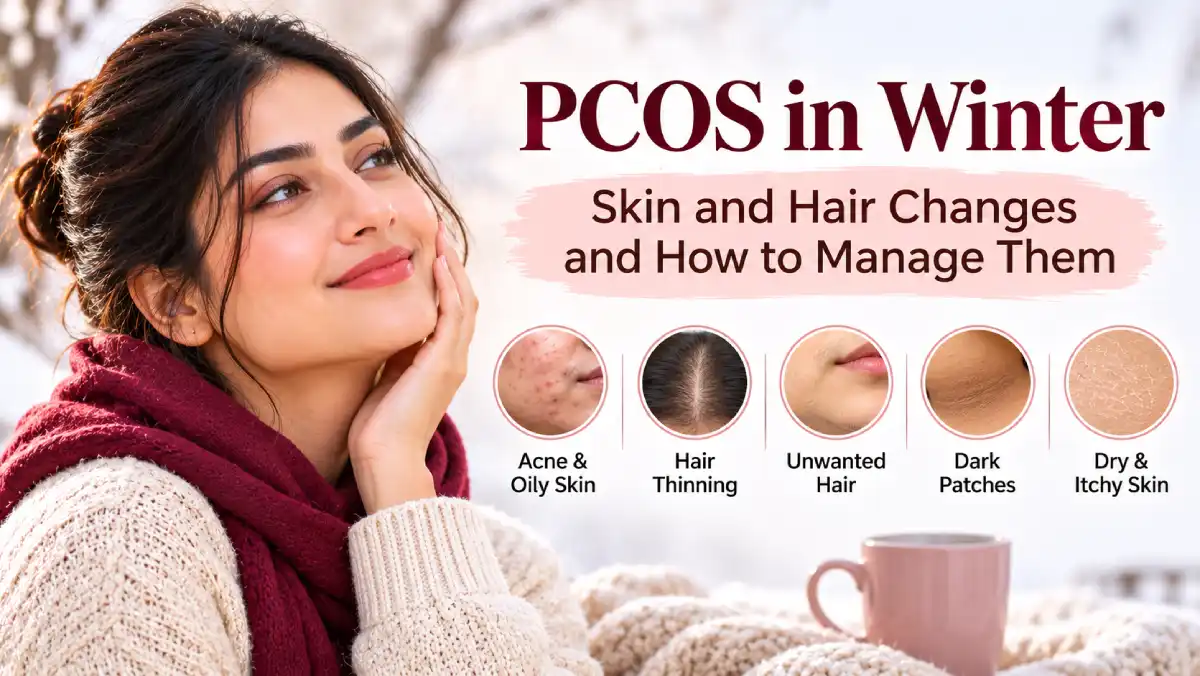
Summary: PCOS can cause acne, oily skin, hair thinning, unwanted hair and dark patches on the neck. In winter, dry air, room heaters, less activity and heavier winter food can change how these problems look and feel. Acne-prone PCOS skin may feel oily and dry at the same time, and winter hair fall can be confused with PCOS-related hair thinning. A light non-comedogenic moisturiser, daily sunscreen, gentle scalp care and a check-up with a dermatologist for persistent symptoms help the most.
PCOS (polycystic ovary syndrome), also commonly called PCOD in India, is one of the most common hormonal conditions in women. While it is often discussed in terms of periods and weight, many women first notice it through their skin and hair: stubborn acne along the jawline, more scalp showing through the parting, thick dark hairs appearing on the chin, or a stubborn darkened band of skin around the neck.
Once the cold sets in, many of our patients find these PCOS concerns start behaving differently. Some find their acne-prone skin suddenly turns dry and flaky, others notice more hair on the comb, and some see their dark neck patches more clearly against collars and scarves. In this guide, Dr Asma Parveen, a dermatologist in Lucknow, explains how PCOS affects the skin and hair, what changes in the colder months, and simple ways to manage it.
Skin and hair symptoms of PCOS, and why winter matters
Why PCOS affects the skin and hair
In PCOS, the body often makes higher levels of androgens, sometimes called “male” hormones, such as testosterone. Alongside this, a large number of women with PCOS have insulin resistance, meaning the body’s cells don’t react to insulin properly, so it ends up making more of it. This hormone imbalance can:
- Increase oil production in the skin, leading to acne
- Thin the hair on the scalp over time
- Cause coarse, dark hair to grow on the face, chest or tummy
- Lead to thickened, darker skin in body creases such as the neck and underarms, often tied to high insulin levels
These symptoms are not only seen in women who are overweight. Women with lean or thin PCOS can have them too.
Common skin and hair symptoms of PCOS
Symptom | What you may notice |
Acne | Deep, sore pimples, often on the jawline, chin and neck |
Oily skin and scalp | Shine on the T-zone, greasy hair soon after washing |
Hair thinning | A wider parting or thinning at the crown |
Unwanted hair | Coarse hair on the upper lip, chin, chest or tummy |
Dark patches | Velvety, darker skin on the neck, underarms or groin |
Why winter can make a difference
Winter doesn’t cause PCOS, but it can change how its symptoms behave:
- Dry air and room heaters pull moisture from the skin, even when it is oily.
- Less physical activity on cold, foggy days.
- Heavier winter food such as gajar halwa, gud, til laddoo, pakoras and festive sweets.
- Drinking less water because you don’t feel thirsty.
- Less sunlight, as more time is spent indoors.
- Layers of woollens and scarves, which can rub against sensitive areas.
PCOS acne in winter
Is PCOS acne worse in winter?
It depends on the person. Studies on whether acne changes with the seasons have shown mixed results. Some women with PCOS find their acne settles a little in winter, while others notice more breakouts. What does commonly change in winter is how the skin around the acne feels, and how well it tolerates acne treatment.
Oily but dry: the winter combination
Many women with PCOS have oily, acne-prone skin. In winter, the same skin can also feel tight, rough and flaky, especially on the cheeks and around the nose. This happens because the outer layer of the skin loses water in dry air, even while the oil glands stay active. Dry, irritated skin can then become more sensitive to acne products.
Winter habits that can make PCOS acne worse
- Applying heavy creams, ghee or oils on the face to treat dryness, which can clog pores
- Scrubbing flaky skin with rough scrubs or towels
- Stopping moisturiser because of the fear that it will cause pimples
- Very hot water for washing the face
- Touching or picking pimples under scarves and mufflers
Using acne treatments in dry weather
Common acne treatments, such as retinoids and benzoyl peroxide, can make the skin drier and may sting more in winter. Some women with severe PCOS acne are prescribed isotretinoin, which can cause marked dryness of the skin and lips, especially in the cold months.
Don’t stop prescribed treatment on your own. Instead, ask your dermatologist whether to adjust how often you use it, and pair it with a suitable non-comedogenic moisturiser.
Itchy, dry skin with PCOS
Some women with PCOS notice itchy, dry patches on the arms, legs or back in winter. Dry winter air, hot baths and woollen clothes on bare skin all add to it.
Simple winter care:
- Bathe with lukewarm water, not very hot water.
- Apply a fragrance-free moisturiser on the body within a few minutes of bathing.
- Wear a cotton layer under woollens.
- Keep nails short to reduce damage from scratching.
See a dermatologist if the itching disturbs sleep, comes with a rash, or doesn’t improve with regular moisturising. Persistent itching can have other causes, such as a fungal infection, eczema or thyroid problems, which need proper diagnosis.
PCOS hair thinning vs winter hair fall: how to tell the difference
Many women notice more hair on the comb and pillow in winter and worry it is PCOS. Sometimes it is simple seasonal shedding, and sometimes it is PCOS-related hair thinning, also called female pattern hair loss. They look different and need different care.
Winter hair fall (shedding) | PCOS-related hair thinning | |
How it starts | Suddenly, often over a few weeks | Gradually, over months or years |
Where you notice it | All over the scalp, more hair on the comb and in the shower | A widening parting and thinning at the top or crown |
Hairline | Usually unchanged | Front hairline is often kept, but the top looks thinner |
How long it lasts | Usually settles within a few months | Tends to continue without treatment |
Other signs | Dry scalp, recent illness or stress | Acne, unwanted hair, irregular periods |
If your hair fall is mainly seasonal, simple care often helps. Read more about why hair fall increases during winter. If you notice a wider parting or thinning at the crown, it is worth seeing a dermatologist, because PCOS-related thinning usually needs medical treatment rather than home remedies alone.
Tests your doctor may suggest
Hair fall in women often has more than one cause. Depending on your symptoms, your doctor may suggest tests such as:
- Thyroid function, as thyroid problems can also cause hair fall and dry skin
- Iron levels and haemoglobin
- Vitamin D and vitamin B12
- Hormone tests, often in coordination with your gynaecologist
Treatment options for PCOS hair thinning
Treatment is planned after examining your scalp and checking for other causes. Your dermatologist may suggest options such as topical minoxidil, medicines that reduce the effect of androgens, or in-clinic hair treatments. Results take time, often several months, and vary from person to person.
Dark patches on the neck and underarms (acanthosis nigricans)
Some women with PCOS notice dark, thick, velvety skin on the back of the neck, underarms, groin or under the breasts. This is called acanthosis nigricans. It is commonly linked to insulin resistance, which is often seen alongside PCOS.
In winter, these patches can become more noticeable, and high collars, scarves, mufflers and tight woollens may rub against them, making the skin feel rough or irritated.
A common myth: these patches are not dirt, so scrubbing, lemon, baking soda or bleach won’t remove them. These can irritate the skin and sometimes make it darker.
It is worth getting dark patches checked by a doctor. Because they can be a sign of insulin resistance, your doctor may suggest a blood sugar test. Managing the underlying cause, along with treatment advised by your dermatologist, may help the patches look lighter over time.
Painful lumps in the armpits or groin (hidradenitis suppurativa)
Hidradenitis suppurativa (HS) is a long-term skin condition that causes painful lumps, boils or tunnels under the skin, usually in the armpits, groin, under the breasts or on the inner thighs. Research has found that HS is more common in women with PCOS than in women without it.
In winter, tight layers, synthetic innerwear and sweating under heavy clothes can increase friction in these areas. Wear loose, breathable cotton next to the skin, and don’t squeeze or pop the lumps.
HS is often mistaken for simple boils, which can delay the right treatment. If you have painful lumps that keep coming back in the same areas, see a dermatologist early.
Unwanted facial and body hair: is winter a good time to start laser?
Unwanted hair on the face, chest or tummy (hirsutism) is one of the most common PCOS skin concerns. For many women, winter can be a practical time to start laser hair reduction, because the skin is usually less tanned and it is easier to avoid strong sun between sessions.
Laser hair reduction for PCOS usually needs several sessions and maintenance, and works best alongside treatment of the underlying hormone imbalance. We’ve explained this in detail in our guide on PCOS hair removal and laser treatment.
Treatment for PCOS skin and hair problems
There is no single treatment that cures PCOS, but its skin and hair symptoms can usually be managed well. After examining your skin and scalp, your dermatologist may suggest:
- For acne: prescription creams or gels, oral medicines, and in some cases chemical peels
- For acne marks and scars: peels or laser treatments, planned once active acne is under control
- For hair thinning: topical treatments such as minoxidil, medicines that reduce the effect of androgens, or in-clinic hair treatments
- For unwanted hair: laser hair reduction, alongside medical treatment
- For dark patches and hidradenitis suppurativa: medical treatment, together with managing insulin resistance where present
Some treatments, such as certain hormone medicines, are prescribed together with your gynaecologist or endocrinologist. Every treatment has possible side effects, and results vary from person to person.
Managing PCOS skin and hair in winter: a simple daily routine
Morning
- Gentle, non-foaming or mild gel cleanser
- Any prescribed treatment, if advised for the morning
- Light, non-comedogenic moisturiser
- Broad-spectrum sunscreen (SPF 30 or higher), even on foggy days
Night
- Gentle cleanser to remove dust, smog and sunscreen
- Prescribed acne or hair treatment, as advised
- Moisturiser, a little more generous on dry patches
Hair and scalp
- Wash regularly with a mild or anti-dandruff shampoo
- Conditioner on the lengths only
- Less heat styling and tight hairstyles
What to avoid in winter
- Heavy oils, ghee or thick creams on acne-prone areas of the face
- Harsh scrubs, lemon or baking soda on the skin
- “Fairness” or mixed creams bought from the chemist without a prescription, which may contain steroids
- Starting several new products at the same time
Winter lifestyle habits that can affect PCOS skin
- Eating for PCOS in winter: enjoy seasonal foods, but keep sweets, fried snacks and sugary drinks in moderation. Include seasonal vegetables, fruits, dals and enough protein in your meals.
- Drink enough water: you may not feel thirsty in the cold, but your skin still needs it.
- Working out with PCOS in winter: on cold or foggy days, try indoor options such as brisk walking at home, yoga or stair climbing. Regular activity can help with insulin resistance.
- Sleep and stress: late nights and stress can affect hormones and skin. Try to keep a regular sleep routine.
- Sunlight: you may spend less time outdoors in winter. Ask your doctor whether you need a vitamin D test, rather than starting supplements on your own.
If you need a food or weight plan made just for you, your gynaecologist, endocrinologist or a registered dietitian is the right person to guide you.
Why PCOS needs team care
PCOS affects more than the skin, so the best results usually come from doctors working together:
Doctor | What they look after |
Dermatologist | Acne, hair thinning, unwanted hair, dark patches, hidradenitis suppurativa and other skin and hair problems |
Gynaecologist | Periods, ovaries, fertility and hormone treatment |
Endocrinologist | Hormone imbalance, insulin resistance, thyroid and blood sugar |
Dietitian | Food habits and weight management, if needed |
When acne, hair or skin changes are what bother you most, a dermatologist is a good first stop. If you have irregular periods or other PCOS symptoms, your dermatologist may also advise seeing a gynaecologist, or work alongside the doctor already treating you.
When to see a dermatologist
See a dermatologist if you notice:
- Painful acne, acne that leaves marks or scars, or acne that doesn’t improve with basic care
- A widening parting, thinning at the crown, or hair fall lasting more than two to three months
- New dark, velvety patches on the neck, underarms or groin
- Painful lumps or boils that keep coming back in the armpits or groin
- Unwanted hair that is increasing quickly
- Itching or dryness that disturbs your sleep
At The Velvet Skin Centre, Dr Asma Parveen, a skin doctor in Lucknow, examines your skin, hair and scalp, looks at the possible causes, and suggests a treatment plan suited to you, coordinating with your other doctors where needed.
Clinic information
Indira Nagar: The Velvet Skin Centre, 23, Amrapali Market, B Block, Indira Nagar, Lucknow – 226016
Thakurganj: The Velvet Skin Centre, Near Ghante Wala Sweets, Daulatganj, Thakurganj, Lucknow – 226003
Frequently asked questions
1. Is PCOS the same as PCOD?
In India, both terms are commonly used for the same condition. Doctors usually prefer “PCOS” (polycystic ovary syndrome), because it affects hormones and metabolism, not just the ovaries.
2. Can PCOS be cured?
There is currently no permanent cure for PCOS, but it can be managed. With the right treatment and lifestyle support, skin and hair symptoms such as acne, hair thinning and unwanted hair can often be controlled well.
3. Does PCOS make your skin worse in winter?
Not for everyone. Winter doesn’t worsen PCOS itself, but dry air, heaters, less activity and heavier food can make acne-prone skin feel dry and sensitive, and make hair fall or dark patches more noticeable.
4. Can PCOS hair loss be reversed?
Early treatment can help slow down hair thinning, and some women see regrowth. Results take several months and vary. The earlier you start, the better the chances of keeping your existing hair.
5. Is the dark neck from PCOS permanent?
Not always. Dark patches linked to insulin resistance may become lighter when the underlying cause is managed, along with treatment advised by a dermatologist. Scrubbing won’t remove them.
6. What moisturiser is good for PCOS acne-prone skin?
A light, fragrance-free, non-comedogenic moisturiser, such as a gel-cream, is usually a good choice. Avoid heavy oils and thick creams on acne-prone areas.
7.Should I see a dermatologist or a gynaecologist for PCOS skin problems?
For acne, hair thinning, unwanted hair or dark patches, start with a dermatologist. For periods, fertility or hormone treatment, see a gynaecologist. Many women benefit from both.
8. Is winter a good time to start laser hair removal for PCOS?
For many people, yes. With less tanning in the colder months, it’s simpler to keep your skin out of strong sun between sessions. Your dermatologist will check whether laser suits your skin and hair type.

Dr Asma Parveen, MD (Dermatology)
Founder of The Velvet Skin Centre and Dr Asma M.D. Skin Clinic, Chowk, with over 14 years of experience treating skin and hair concerns in Lucknow. She consults at Indira Nagar, Thakurganj and Chowk.
Note: This blog is for general awareness only and is not a substitute for a medical consultation. PCOS affects each person differently. Please consult a qualified doctor before starting or changing any treatment. Results vary from person to person.
References
- https://eprints.soton.ac.uk/484749/1/dead156.pdf
- https://pubmed.ncbi.nlm.nih.gov/29378201/
- https://pubmed.ncbi.nlm.nih.gov/36226726/
- https://read.qxmd.com/read/30785992/female-pattern-hair-loss-and-androgen-excess-a-report-from-the-multidisciplinary-androgen-excess-and-pcos-committee
- https://aad.org/diseases/a-z/acanthosis-nigricans-overview
- https://www.health.harvard.edu/blog/polycystic-ovarian-syndrome-and-the-skin-202104292552
- https://www.medicalnewstoday.com/articles/hormonal-acne-worse-in-winter
- https://mhealth.medicaldialogues.in/article/health-topics/winter-and-pcos-why-symptoms-worsen-for-some-individuals-and-what-actually-helps-dr-akriti-gupta-160467
- https://betterhealth.vic.gov.au/health/conditionsandtreatments/polycystic-ovarian-syndrome-pcos