
Medically reviewed by Dr Asma Parveen, MD (Dermatology),
Summary: Skin boosters are injectable treatments that aim to improve the quality of your skin, such as its hydration, texture, smoothness and firmness, rather than adding volume or changing the shape of the face. Common types include Skinvive, Profhilo, Restylane Vital, NCTF 135 HA and PDRN or PN treatments. Each works in a slightly different way, so the right option depends on your skin and goals, and a consultation with a dermatologist is essential before treatment.
When people talk about injectable skin treatments, they usually mean Botox, fillers or bio-stimulators. But there is another category that many patients ask about: skin boosters. They are often chosen by people who want skin that looks more hydrated and fresh, without any change to their facial features.
In this guide, Dr Asma Parveen explains what skin boosters are, how they differ from other injectables, the main types available, who they may suit, what to expect during and after treatment, how to plan them before a wedding or event, and what to look for in a skin booster clinic in Lucknow.
What are skin boosters?
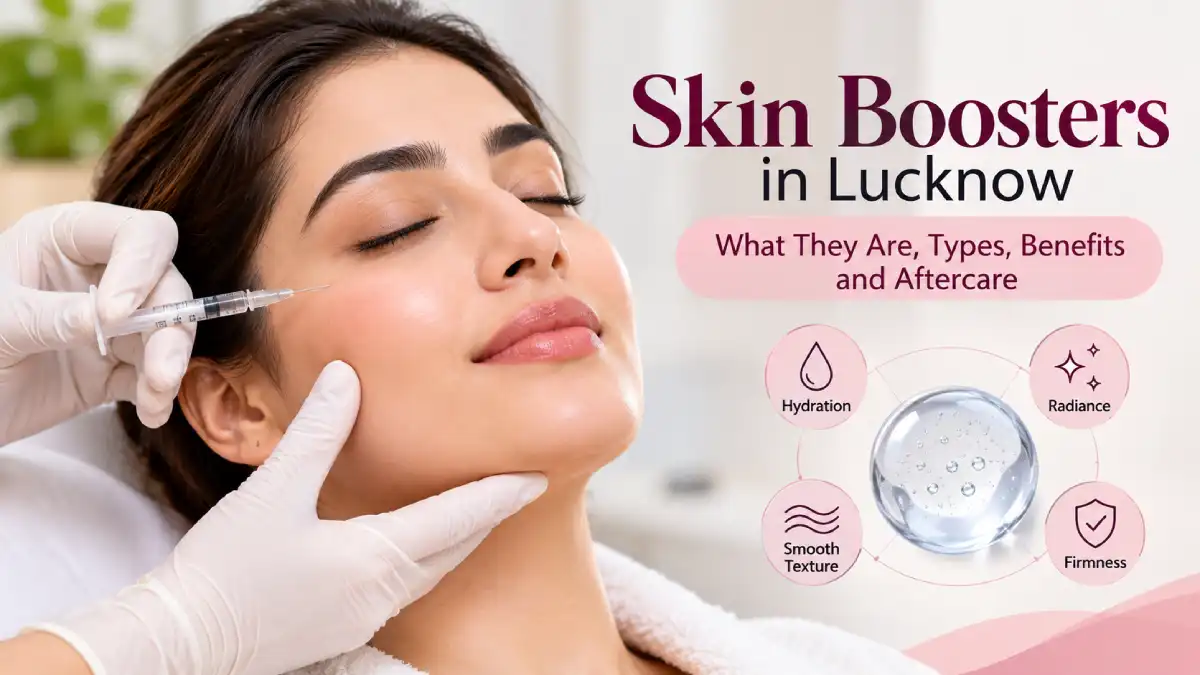
Skin boosters belong to a group of injectables made for one job: improving how healthy your skin looks and feels, not how your face is shaped. Instead of filling lines or lifting areas, they aim to improve hydration, texture, smoothness and firmness, so the skin looks healthier and more refreshed.
Most skin boosters are based on hyaluronic acid, a substance naturally found in the skin that helps it hold water. Some also contain vitamins, amino acids and other ingredients, while newer options use DNA-derived compounds called polynucleotides. They are injected in tiny amounts into the skin, and how they work depends on what they contain.
Skin boosters vs Botox, fillers and bio-stimulators
Treatment | What it mainly does | Typical use |
Botox (botulinum toxin) | Relaxes specific facial muscles | Softening expression lines, such as forehead lines and crow’s feet |
Dermal fillers | Add volume and shape | Restoring lost volume, contouring cheeks, lips or jawline |
Bio-stimulators | Encourage the skin to build its own collagen over time | Gradual improvement in firmness and skin laxity |
Skin boosters | Improve hydration and skin quality | Dryness, dullness, rough texture and fine crepey lines |
These treatments are not either-or. A dermatologist may suggest one, or a combination, depending on what your skin needs.
Types of skin boosters and how they work
Skin boosters are grouped by what they contain. Here are the main types a dermatologist may discuss with you.
1. Skinvive by Juvéderm
Skinvive is a cross-linked hyaluronic acid treatment given as tiny microdroplets into the dermis, the deeper layer of the skin. Its main role is hydration. It is designed to improve the smoothness and quality of the skin on the cheeks, giving a fresher, glowing look without adding volume.
2. Profhilo
Profhilo is a stabilised hyaluronic acid treatment, often described as “bioremodelling”. It is injected at a few fixed points on each side of the face and spreads gently under the skin. It aims to improve hydration, firmness and elasticity, and is usually given as a course of two sessions about a month apart, depending on the doctor’s plan.
3. Restylane Vital
Restylane Vital is a stabilised hyaluronic acid skin booster given as many small injections across the treated area. It aims to improve hydration, smoothness and elasticity, and is commonly planned as a short course of sessions.
4. NCTF 135 HA by Fillmed
NCTF 135 HA is a skin revitalisation formula that combines hyaluronic acid with vitamins, amino acids, minerals and other ingredients. It is usually given as a series of sessions and aims to support hydration, radiance and overall skin quality.
5. PDRN and PN treatments
PDRN (polydeoxyribonucleotide) and PN (polynucleotides) are DNA-derived compounds, commonly sourced from salmon. They are an emerging area in aesthetic dermatology and are being studied for their possible role in skin repair and rejuvenation. Your dermatologist can explain the current evidence and whether they suit you.
At a glance
Skin booster | Main ingredient | Main focus |
Skinvive | Cross-linked hyaluronic acid microdroplets | Hydration and smoothness of cheek skin |
Profhilo | Stabilised hyaluronic acid | Hydration, firmness and elasticity |
Restylane Vital | Stabilised hyaluronic acid | Hydration and smoothness |
NCTF 135 HA | Hyaluronic acid with vitamins, amino acids and minerals | Radiance and overall skin quality |
PDRN / PN | DNA-derived polynucleotides | Skin repair and rejuvenation (emerging) |
Possible benefits of skin boosters
Results vary from person to person, but skin boosters may help with:
- Better skin hydration
- Smoother, softer-feeling skin
- Improved skin texture
- A fresher, more radiant look
- Support for skin firmness and elasticity
- A smoother base for makeup
The changes are usually gradual and natural-looking. Skin boosters do not change the shape of your face, so they won’t make you look “done”.
Who may consider skin boosters?
Skin boosters are often discussed with people who have:
- Dry, dehydrated or dull skin, including skin that dries out in Lucknow’s winter
- Rough texture or fine, crepey lines on the cheeks
- Early loss of firmness, without major volume loss
- A wish for fresher-looking skin without changing their features
If your main concern is deep lines, lost volume or sagging, other treatments may suit you better. A dermatologist can advise after examining your skin.
Planning skin boosters before a wedding
Many brides, grooms and family members ask about skin boosters before a wedding. Because most skin boosters work gradually and some need more than one session, it helps to plan early:
- Start about 3 months before the wedding. This gives time for a course of sessions and for the skin to settle.
- Keep the last session at least 2 to 3 weeks before the big day, so any swelling or small bruises have time to fade.
- Don’t try a new injectable for the first time in the final week.
Your dermatologist will plan the timing based on the product chosen and how your skin responds.
How are skin boosters given?
The product is placed in tiny amounts within the skin itself, most often in the dermis, which sits just beneath the outer layer. The way they are injected depends on the product:
- Microdroplet injections: many tiny injections spread evenly across the treated area, such as the cheeks. Products like Skinvive and Restylane Vital are usually given this way.
- A few fixed injection points: Profhilo is injected at a small number of set points on each side of the face, and then spreads gently under the skin.
- Mesotherapy-style injections: formulas like NCTF 135 HA are given as many very small, shallow injections, and in some cases with a microneedling device.
The doctor may use a fine needle or a blunt cannula, depending on the area and product. A numbing cream is often applied first. Some skin boosters need only one session, while others are given as a course of two or more sessions a few weeks apart, followed by maintenance sessions if needed.
What happens during a skin booster session?
- Consultation: the dermatologist examines your skin, asks about your health, medicines and allergies, and explains which option may suit you, along with its risks.
- Preparation: the skin is cleansed, and a numbing cream may be applied to reduce discomfort.
- Injections: the product is injected in small amounts at planned points, using a fine needle or cannula.
- After the session: the area is cleaned, and you receive aftercare advice.
Most sessions take about 30 to 45 minutes, and many people return to their daily routine the same day.
Possible side effects
Skin boosters are a medical procedure, and some people notice side effects afterwards. Common ones are usually mild and short-lived:
- Redness, swelling or tenderness at the injection points
- Small bumps that settle over a few days
- Bruising
Less common but more serious complications can include infection, allergic reactions or, rarely, blockage of a blood vessel. Contact your doctor straight away if you notice increasing pain, skin colour changes, blistering or swelling that gets worse. This is one reason skin boosters should only be given by a qualified doctor in a proper clinical setting.
Who should avoid or delay skin boosters?
Tell your doctor if you:
- Are pregnant or breastfeeding
- Have an active skin infection, acne flare or cold sores in the area
- Have a history of severe allergies or allergy to any ingredient
- Take blood-thinning medicines
- Have an autoimmune condition, a bleeding disorder or keloid-prone skin
- Have had other treatments in the same area recently
In these cases, the doctor may suggest waiting, a different treatment, or no treatment.
Aftercare tips
- Avoid touching, pressing or massaging the area unless your doctor advises it.
- Skip makeup for about 12 to 24 hours.
- Avoid heavy exercise, saunas, steam and very hot showers for a day or two.
- Apply sunscreen every morning and shield your face from strong sun while the skin settles.
- Keep follow-up visits as planned, and contact the clinic if anything worries you.
Which skin booster is right for you?
What works well for one person’s skin may not be ideal for another’s. Skinvive, Profhilo, Restylane Vital, NCTF 135 HA and PDRN work differently, and the right choice depends on your skin condition, your main concern, your age, your budget and your timeline.
Before any injectable, it’s important to have your skin examined by a qualified dermatologist. The doctor will check whether a skin booster is suitable for you at all, or whether another option, such as a HydraFacial, a peel or a different injectable, may fit your goals better.
How much does a skin booster cost in India?
The cost of skin boosters in India varies widely. Publicly listed prices at clinics across India generally range from about ₹7,000 to ₹40,000 per session. Because many skin boosters are given as a course, the total cost of treatment is often higher than the price of one session.
The final cost depends on:
- The product used: for example, Skinvive, Profhilo, NCTF 135 HA or PDRN each cost differently
- The area treated: face, neck, hands or more than one area
- The number of sessions in your treatment plan, and any maintenance sessions
- Your skin concern, which decides the product and amount needed
- The doctor’s experience and the clinic’s setting
Be careful with prices that seem unusually low. They can sometimes mean non-genuine products or treatment by someone who isn’t qualified. At The Velvet Skin Centre, the doctor explains the treatment plan and its full cost after examining your skin, before you decide.
Choosing a skin booster clinic in Lucknow
Skin boosters are medical procedures, so where you get them matters. When choosing a skin booster clinic in Lucknow, look for:
- A qualified dermatologist who examines your skin and performs or directly supervises the treatment
- A clear explanation of the product, number of sessions, possible side effects and costs before you begin
- Genuine, sealed products, opened in front of you
- A clean clinical setting, and a plan for follow-up if you have any concerns
At The Velvet Skin Centre, a skin booster clinic in Lucknow, Dr Asma Parveen (MD, Dermatology) assesses your skin before suggesting any skin rejuvenation treatment. Skin booster options discussed at the clinic include:
- Skinvive treatment in Lucknow
- Profhilo treatment in Lucknow
- NCTF 135 HA in Lucknow
- PDRN skin treatment in Lucknow
- Skin rejuvenation and bioremodelling in Lucknow
Clinic information
Indira Nagar: The Velvet Skin Centre, 23, Amrapali Market, B Block, Indira Nagar, Lucknow – 226016
Thakurganj: The Velvet Skin Centre, Near Ghante Wala Sweets, Daulatganj, Thakurganj, Lucknow – 226003
Frequently asked questions
1. What is the difference between skin boosters and fillers?
Fillers add volume and shape to areas like the cheeks, lips or jawline. Skin boosters focus on skin quality, such as hydration, texture and smoothness, and are not meant to change the shape of the face.
2. How long do skin booster results last?
It depends on the product, your skin and your lifestyle. Effects usually last several months, and many people choose maintenance sessions as advised by their doctor.
3. How many sessions will I need?
Some skin boosters are given as a single session, while others work best as a course of two or more sessions a few weeks apart. Your dermatologist will suggest a plan.
4. How are skin boosters given?
They are injected into the skin in small amounts, either as many tiny microdroplets, at a few fixed points, or as shallow mesotherapy-style injections, depending on the product. A numbing cream is often used first.
5. How much does a skin booster cost in India?
Publicly listed prices at clinics in India generally range from about ₹7,000 to ₹40,000 per session. The total depends on the product, the area treated and the number of sessions you need.
6. Are skin boosters painful?
Most people feel only mild discomfort. A numbing cream is often applied first to make the injections more comfortable.
7. When should I get skin boosters before my wedding?
Ideally start about 3 months before, and keep your last session at least 2 to 3 weeks before the wedding.
8. Is Skinvive the same as Profhilo?
No. Both are based on hyaluronic acid, but they are different products, injected in different ways and suited to different needs. Your dermatologist can explain which may fit your skin.
9. How do I choose a skin booster clinic in Lucknow?
Choose a clinic where a qualified dermatologist examines your skin first, explains the product, sessions, risks and costs clearly, uses genuine sealed products, and offers follow-up care.

Dr Asma Parveen, MD (Dermatology)
Founder of The Velvet Skin Centre and Dr Asma M.D. Skin Clinic, Chowk, with over 14 years of experience treating skin and hair concerns in Lucknow. She consults at Indira Nagar, Thakurganj and Chowk.
Note: This blog is for general awareness only and is not a substitute for a medical consultation. Skin booster treatments are medical procedures and should only be performed by a qualified doctor. Results vary from person to person, and every treatment carries possible risks.