

Advancements in AI-Powered Dermoscopy for Early Melanoma Detection
Summary: Artificial intelligence is transforming dermatology, especially in the early detection of melanoma—the deadliest form of skin cancer. While traditional dermoscopy improves accuracy, it often struggles with subtle or atypical cases. AI-powered dermoscopy enhances this process by analysing dermoscopic images with deep-learning algorithms, identifying microscopic patterns beyond human perception. Studies show AI can match or even outperform expert dermatologists, improving sensitivity and reducing unnecessary biopsies. At The Velvet Skin Centre in Lucknow, Dr Asma Parveen tracks these innovations closely, recognising their potential to make skin cancer screening faster, more accurate, and accessible to more patients in the future.
Dermatology is in the middle of a digital revolution. With artificial intelligence (AI) now reshaping healthcare across specialities, one area showing exceptional promise is melanoma detection through AI-powered dermoscopy.
Why does this matter? Melanoma may represent just 1% of all skin cancers, but it accounts for the majority of skin cancer-related deaths worldwide. When caught early, melanoma has a survival rate of over 99%—but once it spreads to distant organs, survival plummets to about 27%. This dramatic contrast underscores the critical need for earlier, more reliable detection methods..
At The Velvet Skin Centre in Lucknow, Dr. Asma Parveen, a leading dermatologist in Lucknow, is closely monitoring innovations in AI-based dermoscopy that are likely to become part of mainstream dermatology practice in the near future.
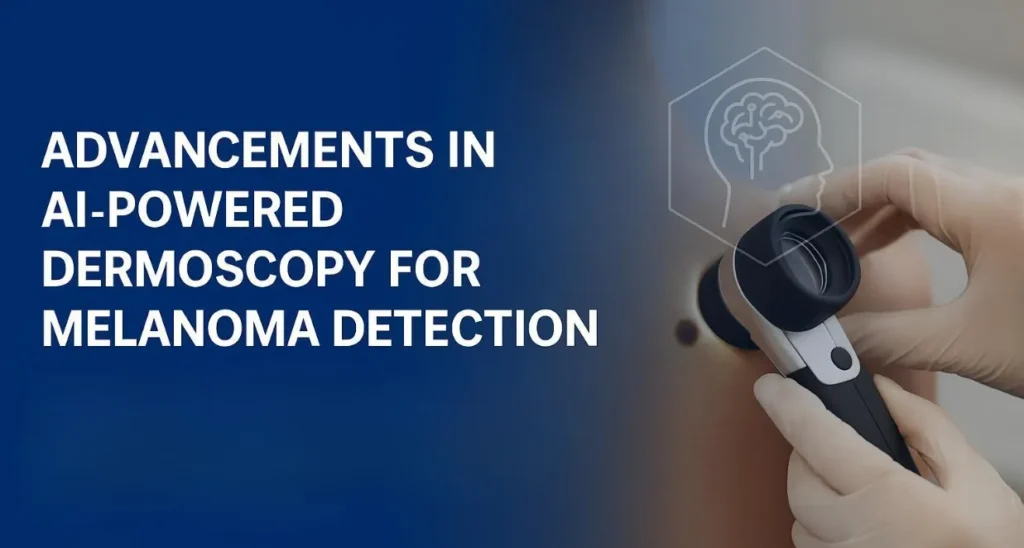
The Challenge of Traditional Melanoma Detection
For decades, dermatologists have relied on clinical examinations and dermoscopy—a magnified imaging technique that helps visualize skin lesions in greater detail. While dermoscopy improved accuracy compared to naked-eye inspections, it still comes with challenges:
- Variability in expertise: Sensitivity for melanoma detection varies from 60% to 90% depending on the clinician.
- Featureless melanomas: Not all melanomas show the “ABCDE” (Asymmetry, Border, Color, Diameter, Evolution) warning signs. Early-stage or amelanotic melanomas may look deceptively benign.
- Unnecessary biopsies: To avoid missing melanoma, dermatologists may biopsy many suspicious but ultimately benign lesions.
These challenges highlight the need for tools that combine human expertise with advanced pattern-recognition capabilities.
Enter AI-Powered Dermoscopy: A Game-Changer
AI dermoscopy uses deep learning algorithms trained on massive image datasets to identify patterns, colors, and vascular features that may be invisible to the human eye. By functioning as a powerful second-opinion tool, AI is not replacing dermatologists—but making them more accurate and confident.
How AI Dermoscopy Works
- Image Capture: High-resolution dermoscopic images are taken with specialized cameras.
- Preprocessing: The AI cleans up distortions—adjusting for lighting, hair, or poor focus.
- Feature Extraction: Hundreds of microscopic features—such as pigment networks, vascular distribution, and symmetry—are analysed simultaneously.
- Risk Scoring: The system generates a probability score with visual overlays highlighting areas of concern.
This structured analysis reduces oversight and improves early melanoma detection accuracy.
Evidence from Scientific Studies
Several high-impact studies confirm the promise of AI-powered dermoscopy:
- A 2024 Communications Medicine study found that AI systems showed superior performance in melanoma detection compared to traditional dermoscopy methods (source).
- The PROVE-AI study (npj Digital Medicine, 2023) validated open-source AI with an AUC of 0.9490, showing strong accuracy in real-world settings (source).
- A Nature Communications 2025 study highlighted that explainable AI improved dermatologist accuracy by 2.8 percentage points, showing how AI can enhance—not replace—human expertise (source).
- A 2021 Scientific Reports study reported that optimized deep-learning AI actually outperformed every dermatologist tested in dermoscopic melanoma diagnosis (source).
- A 2023 Systematic Review (PMC) showed that AI consistently achieved ROC > 80%, proving its consistency across multiple datasets (source).
These results position AI not just as a supportive tool—but as a major driver in the future of skin cancer detection.
Global and Indian Context
While most of the landmark research originates from Europe and North America, AI dermoscopy is equally relevant in India, where:
- Awareness of melanoma is low, leading to late diagnoses.
- Dermatologist density is far lower in rural areas, where AI-assisted screening could bridge gaps.
- Indian skin tones (Fitzpatrick IV–VI) often show atypical melanoma patterns, where AI trained on diverse datasets could provide critical support.
For cities like Lucknow, AI-powered dermoscopy could be particularly useful in improving diagnostic equity—bringing near-expert screening capabilities to both urban and semi-urban populations.
Real-World Integration Models
- Specialist Enhancement: Dermatologists use AI tools to cross-check ambiguous cases, reducing diagnostic uncertainty.
- Primary Care Support: General practitioners employ AI-enabled dermoscopes to identify lesions requiring specialist referral, reducing both missed cases and unnecessary referrals.
- Telemedicine Expansion: AI + tele-dermatology platforms enable remote screenings. Patients in rural Uttar Pradesh, for instance, could have local imaging with AI-preliminary analysis before dermatologist review.
Case Study Example
A 42-year-old Lucknow-based IT professional visited with a 6mm lesion on his back. Clinically, it resembled a harmless seborrheic keratosis. However, AI flagged subtle asymmetry and unusual vascular distribution. A biopsy confirmed early-stage melanoma.
Early intervention saved the patient from progression, highlighting how AI can catch cases that might otherwise be missed.
Addressing Limitations and Risks
AI is powerful, but not perfect.
- Bias in training data: Many AI systems are trained on lighter skin tones, risking reduced accuracy for darker complexions.
- Over-reliance on algorithms: AI should support, not replace, clinical judgment.
- False positives: Sensitive AI may over-flag benign lesions, leading to unnecessary anxiety or biopsies.
Key takeaway: AI is an aid, not a replacement for dermatologists.
Future of AI in Melanoma Detection
The next 5–10 years will see AI evolve further:
- Multi-modal platforms: Combining dermoscopy with confocal microscopy and genetic profiling.
- Temporal lesion tracking: AI that monitors mole changes over months or years.
- Personalized screening models: AI integrating genetic risk, family history, and lifestyle for individualized monitoring.
- Smartphone dermoscopy: Affordable devices that let patients capture dermoscopic-quality images at home for AI pre-screening.
Patient Journey: What to Expect
For patients, AI dermoscopy could change the diagnostic pathway:
- Initial Consultation: Digital dermoscopic imaging is taken.
- AI Pre-Analysis: Probability scores highlight risk level.
- Dermatologist Review: Results are cross-checked with clinical history.
- Decision: Either reassurance, short-term monitoring, or biopsy.
This combined workflow ensures both speed and accuracy, reducing unnecessary biopsies while catching dangerous lesions earlier.
FAQs – AI in Melanoma Detection
Q1. How accurate is AI compared to dermatologists?
Recent studies show AI can achieve 94–95% accuracy, matching or even exceeding experts when used properly.
Q2. Can AI replace dermatologist visits?
No. AI is a tool that enhances diagnosis. Only a dermatologist can combine AI findings with history, physical examination, and treatment planning.
Q3. Is AI dermoscopy safe?
Yes, it is completely non-invasive. The only concern is ensuring correct interpretation by trained doctors.
Q4. Will AI reduce biopsy rates?
Yes—real-world trials show up to 28% fewer unnecessary biopsies while still maintaining early detection rates.
Q5. Is AI dermoscopy available in Lucknow?
Currently, it is emerging in advanced dermatology centres. At The Velvet Skin Centre, we are actively monitoring its rollout and integrating AI-assisted tools alongside traditional dermoscopy.
Conclusion: The Future Is Hybrid
AI-powered dermoscopy is one of the most exciting developments in modern dermatology. By combining the machine’s ability to detect subtle patterns with the dermatologist’s clinical judgment, we can achieve diagnostic precision far greater than either alone.
For patients, this means fewer unnecessary biopsies, faster reassurance, and—most importantly—earlier detection of melanoma when survival rates are highest.
As this technology becomes more widely available in India, patients in cities like Lucknow can look forward to world-class skin cancer screening closer to home.
At The Velvet Skin Centre, Lucknow, led by Dr. Asma Parveen (Best Dermatologist in Lucknow), we remain committed to combining the latest innovations with compassionate, expert care.
Book your skin consultation today—early detection saves lives.
Visit The Velvet Skin Centre
Indira Nagar: The Velvet Skin Centre, 23, Amrapali Market, B Block, Indira Nagar, Lucknow, Uttar Pradesh 226016
Thakurganj: The Velvet Skin Centre, Near Ghante Wala Sweets, Thakurganj, Daulatganj, Lucknow, Uttar Pradesh 226003
 Call: 8002558860