
A receding hairline or thinning crown often appears gradually, making it easy to dismiss in the early stages. By the time the change becomes clearly visible, follicle miniaturisation has usually been progressing for months or years.
Schedule Your Dermatology Consultation.
Get expert skin and hair care advice.
Male pattern baldness, also known as androgenetic alopecia, is the most common cause of hair loss in men. It is driven by a genetic sensitivity to DHT, a hormone that causes hair follicles to shrink progressively over time. Without treatment, the condition advances in a predictable pattern.
The Velvet Skin Centre offers male pattern baldness treatment in Lucknow under the guidance of Dr. Asma Parveen, a dermatologist with over 14 years of experience. The treatment is planned after a thorough scalp evaluation to identify the stage of hair loss and the most appropriate intervention.
Contact The Velvet Skin Centre to receive 10% OFF your first visit. Call +91 8002558860 to book your consultation.
The cause of male pattern baldness is mainly linked to genetics and the hormone dihydrotestosterone (DHT), which gradually affects hair follicle health over time.

The stage of hair loss determines which treatments are appropriate and what outcomes are realistic. The Hamilton-Norwood Scale is the standard classification system used by dermatologists to assess and communicate the severity of male pattern baldness. It ranges from Stage 1 to Stage 7 and helps determine which treatments are most appropriate at each point.
The hairline begins to recede slightly at the temples, forming a subtle M shape. Hair loss at this stage is minimal and often goes unnoticed. This is the most effective time to begin treatment, as follicles are still largely active and respond well to medical therapy.
Temple recession becomes clearly noticeable, and the M shape deepens. Some men also notice early thinning at the crown. This is the first definitive stage of male pattern baldness and the stage at which most men in Lucknow seek their first consultation. Medical therapy can still produce meaningful results, and non-surgical treatments remain highly effective.
Both the frontal hairline and the crown are clearly affected, with a band of hair still separating the two areas. Treatment at this stage typically involves a combination of medical therapy to stabilise existing hair and regenerative treatments to improve density in thinning areas.
The frontal and crown bald areas begin to connect, and the scalp is clearly visible across the top. Non-surgical treatments can still support remaining follicles, but surgical options become increasingly relevant for meaningful density restoration.
Only a narrow band of hair remains around the sides and back of the scalp. Hair transplant using donor follicles from the DHT-resistant zones at the back and sides is typically the primary option at this stage.
Acting before hair loss becomes visually significant gives the best chance of preserving density and limiting how far the condition progresses. Men who notice any of the following should consider a scalp evaluation without delay.

Problem: The hairline appears to be moving backwards slowly over months. Solution: Early medical therapy with Minoxidil and Finasteride can halt progression and maintain the hairline at this stage.

Problem: The scalp is becoming visible at the top of the head, even though the frontal hairline appears intact. Solution: Crown thinning responds well to PRP or GFC therapy alongside medical treatment when identified early.

Problem: Daily hair fall has increased, and hair density has not recovered over several months.
Solution: A scalp evaluation determines whether the shedding is DHT-driven or due to another condition, and treatment is planned accordingly.

Problem: Father, uncles, or maternal relatives experienced significant hair loss at a relatively young age. Solution: A baseline scalp evaluation in your 20s or early 30s allows for early intervention before visible loss becomes significant.
The Velvet Skin Centre offers treatment for male pattern baldness in Lucknow after a detailed scalp evaluation. The plan is customised based on the stage of hair loss, donor area strength, and follicle condition.
The process begins with a detailed assessment of your scalp, hairline, crown area, and donor density. This helps identify the stage of male pattern baldness and rule out other causes of hair loss.
Once the stage is identified, a personalised treatment plan is created. Each stage requires a different approach:
Treatment may include one or more of the following based on clinical need:
Minoxidil improves blood flow to follicles and extends the growth phase of hair. Finasteride works by reducing DHT levels, helping slow progression and maintain or improve density. Both require consistent use and show visible results over time.
PRP uses concentrated growth factors from the patient’s blood, injected into thinning areas to stimulate follicle activity. It is most effective in early to moderate stages and is often combined with medical treatment.
GFC delivers a higher concentration of growth factors compared to PRP, supporting stronger follicle stimulation in weakened but active areas.
Mesotherapy involves microinjections of vitamins, amino acids, and supportive agents that improve scalp nutrition and follicle strength.
In advanced cases where follicles are no longer active, a FUE hair transplant is used to restore density. Healthy follicles from the donor area are transplanted to bald zones for permanent, natural-looking results.
Based on the plan, treatment is carried out using medical therapy, regenerative procedures, or surgery. All procedures are performed in a controlled clinical environment under dermatological supervision.
Hair response is reviewed over time, and the treatment plan is adjusted based on improvement, stability, or progression of hair loss.
Maintenance therapy is often recommended to support existing hair, slow further thinning, and maintain long-term results after initial improvement.
Results from male pattern baldness treatment develop gradually and depend on the stage of hair loss, the treatment approach, and consistency of follow-through.
Stage | What You Experience | Timeline |
Initial Consultation | Scalp evaluation, Norwood staging, and treatment plan prepared | Day 1 |
Medical Therapy Begins | Minoxidil and Finasteride started, scalp adjusting to treatment | First 4 to 6 weeks |
Reduced Shedding | Daily hair fall begins to slow as follicles stabilise | 6 to 8 weeks |
Early Density Signs | Fine regrowth or reduced thinning is visible in treated areas | 3 to 4 months |
Visible Improvement | Noticeable improvement in hair density and coverage | 4 to 6 months |
Regenerative Sessions | PRP, GFC, or Mesotherapy sessions completed if recommended | Within the first 6 months |
Hair Transplant Results | Transplanted hair grows and settles naturally | 9 to 12 months |
Maintenance Phase | Follow-up sessions and continued medical therapy as advised | Ongoing |
Treatment cost depends on the stage of hair loss, the number and type of interventions required, and whether a surgical or non-surgical approach is recommended. A fixed cost cannot be provided without a scalp evaluation, as the plan is tailored to each patient.
Treatment | Approximate Cost Range | What It Depends On |
Medical Therapy (Minoxidil and Finasteride) | ₹500 to ₹2,000 per month | Prescription type, brand, and dosage |
PRP Therapy | ₹3,000 to ₹8,000 per session | Clinic, doctor experience, session count |
GFC Treatment | ₹3,500 to ₹8,000 per session | Formulation quality and session plan |
Mesotherapy | ₹2,500 to ₹6,000 per session | Ingredient composition and extent of treatment |
Hair Transplant (FUE) | ₹25,000 to ₹2,00,000 and above | Number of grafts, extent of hair loss, donor planning |
Call +91 8002558860 or visit any of the three Velvet Skin Centre locations to understand the cost based on your specific stage of hair loss.
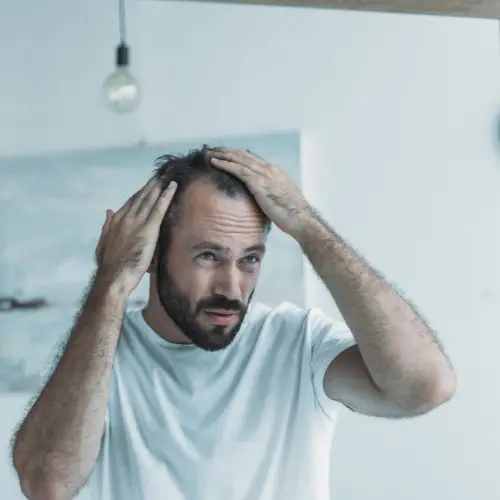
Long-term results depend on continued care, adherence to prescribed treatments, and regular follow-up to monitor how the scalp responds over time.
Dr. Asma Parveen brings over 14 years of dermatology experience to the diagnosis and management of male pattern baldness, with a focused interest in scalp health and hair restoration.
At The Velvet Skin Centre, she evaluates each patient to determine the exact stage and pattern of hair loss before recommending any treatment. For male pattern baldness specifically, this includes a scalp examination, a review of hair loss history, and an assessment of the donor area where relevant.
Her approach involves selecting the right intervention for the right stage rather than applying a fixed protocol. Patients at early stages receive medical and regenerative treatment to preserve existing hair. Patients at advanced stages receive honest surgical planning based on what the donor area can realistically achieve.

Male pattern baldness management often involves more than one treatment, used in combination or in sequence, depending on the stage and response to initial therapy.
Exosomes are microscopic biological messengers that deliver regenerative signals to hair follicles at the cellular level. Exosome therapy is used in cases of chronic or advanced hair thinning where PRP or GFC have not produced sufficient improvement, or as a premium regenerative option for faster results.
Low-level laser therapy uses red light to stimulate hair follicles, improve scalp circulation, and support hair growth. It is used as a supportive treatment alongside medical and regenerative therapies, particularly in early to moderate stages.
Scalp conditions such as seborrhoeic dermatitis or chronic dandruff can accelerate hair loss in men with androgenetic alopecia. Addressing active scalp conditions is often a necessary part of the overall treatment plan.
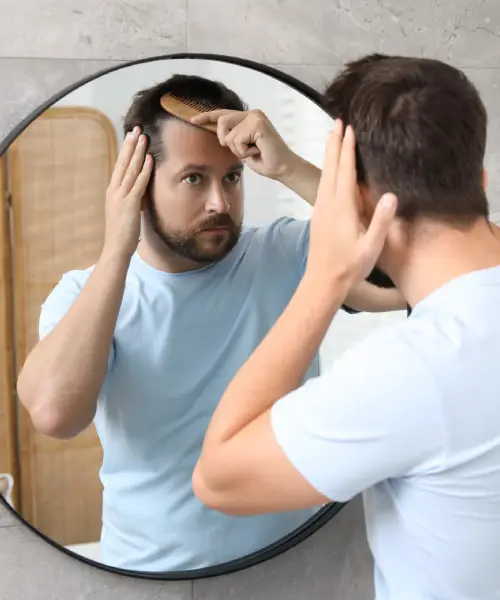
Male pattern baldness outcomes depend on accurate staging, appropriate treatment selection, and consistent follow-up across the full course of care.
If hair loss has progressed to visible thinning or a receding hairline, the next step is an accurate diagnosis rather than continued trial and error.
At The Velvet Skin Centre, Dr. Asma identifies your stage of hair loss and recommends the treatment most appropriate for your condition, whether that is medical therapy, a non-surgical regenerative approach, or a surgical plan for advanced loss.
You can visit the clinic at Indira Nagar, Chowk, or Thakurganj for a consultation. Call +91 8002558860 to book your appointment.
Male pattern baldness cannot be permanently cured as its underlying cause is genetic. However, the right treatment at the right stage can significantly slow progression, maintain existing density, and, in many cases, improve hair thickness in areas where follicles are still active. Early treatment produces the best long-term outcomes.
Male pattern baldness can begin as early as the late teens in men with a strong genetic predisposition. It is most commonly noticed in the 20s and 30s. The earlier it begins, the more likely it is to progress significantly without intervention, which is why early evaluation is important.
For men at Norwood Stage 5 to 7, where follicles in the affected areas are no longer active, hair transplant is usually the most effective option for meaningful density restoration. However, medical therapy is still recommended alongside transplant to protect remaining native hair and maintain overall density.
Medical treatments such as Minoxidil and Finasteride typically show visible results after 3 to 6 months of consistent use. Regenerative treatments such as PRP and GFC produce noticeable improvement in hair density within 3 to 6 months of completing the recommended sessions. Hair transplant results develop gradually, with full growth visible between 9 and 12 months after the procedure.
Yes. Medical treatments such as Minoxidil and Finasteride must be continued to maintain results, as male pattern baldness is a progressive condition driven by ongoing DHT activity. If treatment is stopped, the hair loss process resumes. Transplanted hair is permanent as it comes from DHT-resistant donor follicles, but surrounding native hair may continue to thin without ongoing medical management.
23, Amrapali Market, B Block, Indira Nagar, Lucknow, Uttar Pradesh 226016
Subhash Chandra Bose Complex Mandi Crossing, Victoria St, Chowk, Lucknow, Uttar Pradesh 226003
WhatsApp us