Hair Transplant in Lucknow
Hair loss reaches a stage where treatments no longer provide visible improvement, and the focus shifts to restoring lost density.
Book Now & Get 10% OFF on Your First Visit!
Schedule Your Dermatology Consultation.
Get expert skin and hair care advice
The Velvet Skin Centre offers hair transplant in Lucknow only after a detailed scalp evaluation to determine whether restoration is the right step. Under the guidance of Dr. Asma Parveen, with over 14 years of experience, each case is planned based on your hair loss pattern, donor area strength, and long-term outcome.
The Velvet Skin Centre offers a 10% OFF on your first visit. Call +91 8002558860 to book your consultation and get your scalp evaluated.
What Is a Hair Transplant?
A hair transplant involves moving healthy hair follicles from a donor area, usually the back or sides of the scalp, to areas where hair has thinned or stopped growing.
The aim is not simply to add hair, but to restore density in a way that looks natural. This depends on precise placement, correct growth direction, and careful hairline planning.
Hair transplant is usually considered when follicles in affected areas are no longer active and non-surgical treatments are no longer enough to restore visible density.
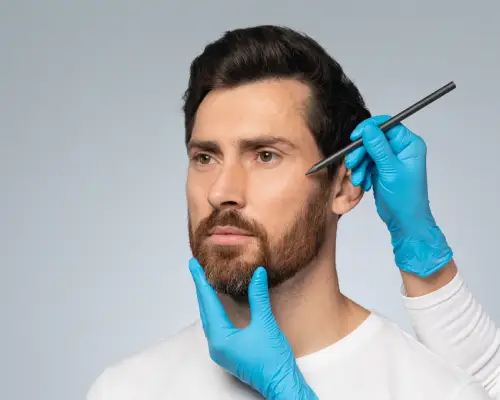
Who Should Consider a Hair Transplant in Lucknow?
Hair transplant is usually considered when hair loss has progressed beyond the stage where regrowth treatments can deliver visible improvement. Identifying the right stage is important for achieving natural and long-term results.
Visible bald patches or receding hairline
Problem: The scalp is clearly visible, and density does not improve with treatments.
Solution: Hair transplant restores coverage by placing active follicles into these areas.
Hair loss not improving with PRP or medication
Problem: Despite treatment, hair thinning continues, and density remains low.
Solution: Hair transplant provides a more permanent solution where follicles are no longer active.
Hair loss pattern has stabilised
Problem: Hair fall has slowed, but the pattern of loss is clearly established.
Solution: A stable pattern allows better planning for natural and long-term results.
Strong donor area at the back of the scalp
Problem: Hair loss is present in one area, but donor hair remains strong.
Solution: Healthy donor follicles can be used to restore density in thinning areas.
Looking for long-term restoration
Problem: Temporary treatments are not giving lasting improvement.
Solution: Hair transplant offers permanent growth from transplanted follicles.
Problem: The scalp is clearly visible, and density does not improve with treatments.
Solution: Hair transplant restores coverage by placing active follicles into these areas.
Problem: Despite treatment, hair thinning continues, and density remains low.
Solution: Hair transplant provides a more permanent solution where follicles are no longer active.
Problem: Hair fall has slowed, but the pattern of loss is clearly established.
Solution: A stable pattern allows better planning for natural and long-term results.
Problem: Hair loss is present in one area, but donor hair remains strong.
Solution: Healthy donor follicles can be used to restore density in thinning areas.
Problem: Temporary treatments are not giving lasting improvement.
Solution: Hair transplant offers permanent growth from transplanted follicles.
You notice: Limited improvement despite using products or medications.
How PRP helps: Enhances follicle performance as part of a structured treatment plan.
Sessions are adjusted based on how your scalp responds, rather than following a fixed routine for every patient.
You can visit The Velvet Skin Centre at Indira Nagar, Chowk, or Thakurganj for consultation and follow-ups.
Along with PRP, options like GFC and mesotherapy are considered when required to improve overall results.
You notice: Thinning is visible, but you are not ready for a transplant.
How PRP helps: Offers a non-surgical option to strengthen existing hair.
How a Hair Transplant Is Actually Performed
A hair transplant is a carefully planned procedure where the outcome depends on accurate assessment, precise extraction, and natural placement of each follicle.

Consultation and scalp mapping
The process begins with a detailed evaluation of your hair loss pattern and donor area. This helps determine the number of grafts required and how they can be used without affecting future density.

Donor area preparation and extraction
Healthy hair follicles are taken from the donor area, usually the back of the scalp. Extraction is done carefully to maintain donor density and preserve follicle quality.

Graft preparation
The extracted follicles are cleaned, sorted, and prepared for implantation. Proper handling at this stage is important to ensure graft survival.

Hairline design and implantation
Follicles are placed into thinning areas following the natural direction, angle, and pattern of your hair growth. The focus is on achieving a natural-looking result rather than simply increasing graft count.

Healing and regrowth phase
After the procedure, the scalp heals over the next few days. Transplanted hair sheds temporarily within a few weeks, followed by gradual regrowth over the next few months.
Hair Transplant Timeline
Hair transplant results develop in phases, and knowing what happens at each stage helps set the right expectations.
Treatment Timeline Overview
|
Stage |
What You Experience |
Timeline |
|
Procedure Day |
Hair transplant is performed, and the scalp is prepared for healing |
Day 1 |
|
Initial Healing |
Mild swelling or scabs form and begin to settle |
7–10 days |
|
Shedding Phase |
Transplanted hair sheds, which is a normal part of the cycle |
2–4 weeks |
|
Early Regrowth |
New hair starts growing from transplanted follicles |
3–4 months |
|
Visible Improvement |
Hair density begins to improve and coverage becomes noticeable |
6–9 months |
|
Final Results |
Full growth and natural appearance settle in |
9–12 months |
-
Hydrafacial Treatment -
Charcoal Facial -
Thread Lift (Face Lift) -
Permanent Makeup -
Piercing (Ear & Nose) -
Photo Facial Treatment -
Chemical Peel Treatment -
Fractional Co2 Treatment -
HIFU Treatment -
Hair Fall Treatment in Lucknow
Cost of Hair Transplant in Lucknow
Hair transplant cost is not fixed, as it depends on your hair loss pattern, donor area strength, and the number of grafts required. The final plan is based on scalp evaluation, not just visible bald areas.
Cost Breakdown
|
Cost Component |
Price Range |
What It Depends On |
|
Per graft cost |
₹25 to ₹60 |
Technique, clinic setup, and precision of extraction |
|
1000 grafts |
₹25,000 to ₹60,000 |
Early hairline correction or small areas |
|
2000 grafts |
₹50,000 to ₹1,20,000 |
Moderate thinning in front or crown |
|
Full procedure |
₹60,000 to ₹2,00,000+ |
Extent of hair loss and density planning |

Meet Dr. Asma, Hair Transplant Surgeon in Lucknow
Dr. Asma Parveen is a dermatologist with over 14 years of experience in dermatology and cosmetology, with a focused interest in hair restoration and scalp treatments.
At The Velvet Skin Centre, she evaluates each case to identify the exact cause and stage of hair loss before recommending treatment. Hair transplant is considered only when non-surgical options are unlikely to deliver a visible improvement.
Her approach combines accurate diagnosis, careful donor area planning, and precise follicle placement to achieve natural-looking results that hold over time.
Tips to Maintain Results After Hair Transplant
Long-term results depend on proper scalp care, consistency, and following post-procedure guidance during the recovery phase.
-
Follow post-procedure instructions carefully: Proper aftercare supports healing and improves graft survival during the initial recovery period. -
Avoid touching or disturbing the scalp: Newly implanted follicles are delicate in the early phase, and avoiding unnecessary contact helps protect them. -
Maintain scalp hygiene: Keeping the scalp clean as advised supports healthy healing and encourages better regrowth. -
Continue supportive treatments if recommended: Treatments like PRP or medical therapy may be suggested to maintain surrounding hair and overall density. -
Track progress over time: Hair growth is gradual, and results become visible over several months rather than weeks.
What Other Treatments Might Be Recommended?
Hair transplant is often combined with supportive treatments to improve overall hair health and maintain long-term results.
PRP (Platelet-Rich Plasma)
PRP may be recommended to support healing after transplant and improve the strength and growth of transplanted as well as existing hair.
GFC (Growth Factor Concentrate)
GFC is used in selected cases to provide additional regenerative support and enhance follicle activity for better density.
Mesotherapy
Mesotherapy helps improve scalp nourishment by delivering essential nutrients directly to the hair roots, supporting overall hair quality.
Medical hair fall treatment
Medical treatment may be advised to manage ongoing hair thinning in areas that have not been treated with transplantation.
PRP may be recommended to support healing after transplant and improve the strength and growth of transplanted as well as existing hair.
GFC is used in selected cases to provide additional regenerative support and enhance follicle activity for better density.
Mesotherapy helps improve scalp nourishment by delivering essential nutrients directly to the hair roots, supporting overall hair quality.
Medical treatment may be advised to manage ongoing hair thinning in areas that have not been treated with transplantation.
Why Patients Choose The Velvet Skin Centre for Hair Transplant in Lucknow
Hair transplant outcomes depend on careful evaluation, proper planning, and long-term follow-up. At The Velvet Skin Centre, each case is assessed in detail to ensure the most suitable treatment approach is chosen for natural and lasting results.
-
Careful evaluation before recommending transplant: Non-surgical options such as PRP, laser therapy, or medical treatment are assessed first before considering surgery, ensuring that transplant is only advised when truly needed. -
Natural hairline planning based on facial balance: Hairline design is done with attention to facial structure and natural growth patterns, aiming for realistic and age-appropriate results rather than artificial density. -
Donor area preservation for long-term balance: Graft extraction is planned carefully to maintain donor area density and ensure long-term hair stability. -
Focus on long-term, natural results: The treatment strategy considers how hair will grow, settle, and age over time, not just the immediate post-procedure appearance. -
Structured follow-up and ongoing care: Post-procedure monitoring is part of the treatment plan, helping track healing, growth, and overall result progression.
Book Your Hair Transplant Consultation in Lucknow
If hair loss has progressed to visible thinning or bald areas, the next step is not rushing into a procedure, but understanding whether a transplant is the right choice.
At The Velvet Skin Centre, each case is evaluated before surgery is recommended. The focus remains on long-term outcome, natural appearance, and safe planning.
You can visit the clinic at Indira Nagar, Chowk, or Thakurganj for consultation. Call +91 8002558860 to understand the most suitable treatment plan for your hair loss. Contact us today.
FAQs
Is hair transplant permanent?
Hair transplant is considered a long-term solution because healthy follicles are taken from areas resistant to hair loss. These transplanted hairs continue to grow naturally, although surrounding non-transplanted hair may still thin over time.
How painful is a hair transplant procedure?
Hair transplant is performed under local anaesthesia, so there is minimal pain during the procedure. Patients may experience mild discomfort or tightness after treatment, which usually resolves within a few days.
How many grafts are needed for a hair transplant?
The number of grafts depends on the extent of hair loss, donor area strength, and desired density. A detailed scalp evaluation is required to determine the exact graft requirement for natural-looking coverage.
When will I see results after a hair transplant?
Initial healing takes about 7 to 10 days. New hair growth usually begins after 3 to 4 months, with visible improvement in density around 6 to 9 months. Final results are typically seen within 9 to 12 months.
Can a hair transplant be combined with PRP or other treatments?
Yes, hair transplant is often combined with PRP, GFC, or medical treatments to improve healing, strengthen existing hair, and support overall long-term density and scalp health.
Hair transplant is considered a long-term solution because healthy follicles are taken from areas resistant to hair loss. These transplanted hairs continue to grow naturally, although surrounding non-transplanted hair may still thin over time.
Hair transplant is performed under local anaesthesia, so there is minimal pain during the procedure. Patients may experience mild discomfort or tightness after treatment, which usually resolves within a few days.
The number of grafts depends on the extent of hair loss, donor area strength, and desired density. A detailed scalp evaluation is required to determine the exact graft requirement for natural-looking coverage.
Initial healing takes about 7 to 10 days. New hair growth usually begins after 3 to 4 months, with visible improvement in density around 6 to 9 months. Final results are typically seen within 9 to 12 months.
Yes, hair transplant is often combined with PRP, GFC, or medical treatments to improve healing, strengthen existing hair, and support overall long-term density and scalp health.
Believe on us
What Our Patients have to Say
[grw id=480][elementor-template id=”6482″]